
About This Worksheet
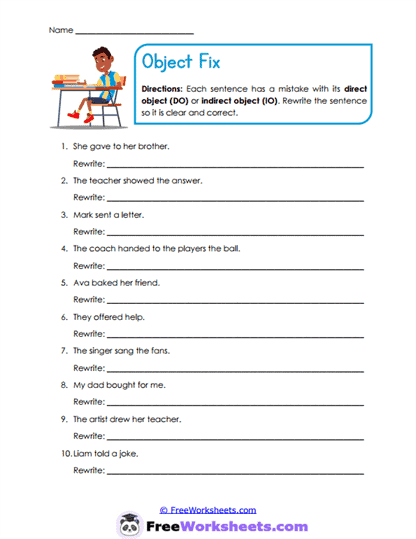
This Grade 7 Language Arts worksheet helps students fix sentences that contain missing, misplaced, or unclear direct and indirect objects. Each example sounds incomplete or confusing because one part of the action is not expressed correctly. Students must decide what the verb needs and then rewrite the sentence so the message is clear. For example, “She gave to her brother” becomes “She gave her brother a gift” or “She gave a gift to her brother.”
Learning Goals
The main goal is to help students recognize when a sentence does not fully answer “what?” and “to whom?” or “for whom?” Students should already know how direct and indirect objects function in a complete sentence. This activity moves them toward editing object errors and rebuilding sentences with logical grammar. It supports CCSS.ELA-LITERACY.L.7.1 and CCSS.ELA-LITERACY.L.7.3 by focusing on standard sentence structure and clarity.
Student Tasks
On this worksheet, students will read ten incorrect sentences and rewrite each one clearly. They may need to add a missing direct object, move an indirect object, or correct the word order. The examples use verbs such as gave, showed, sent, handed, baked, offered, sang, bought, drew, and told. Students should make sure every revised sentence communicates both the action and the people or things involved.
Common Challenges
Some students may repair a sentence by adding random information that does not fit the original meaning. Others may create a grammatically correct sentence that still lacks one of the required objects. A few may confuse a direct object with the object of a preposition. Encourage students to locate the verb first and ask both object questions before writing the correction.
Teaching Suggestions
A teacher can read each faulty sentence aloud and ask students what information feels missing. The class can then suggest several possible repairs and discuss which ones are clear and logical. At home, a parent can ask the child to explain what the original sentence was probably trying to say. This helps students treat grammar correction as a meaning problem, not just a word-order exercise.
Worksheet Features
The page contains ten short error-correction items with long lines for complete rewrites. The mistakes vary, so students must think instead of applying the same correction every time. Familiar situations keep the focus on sentence structure rather than difficult vocabulary. This worksheet is useful for editing practice, reteaching, homework, or independent review.