
About This Worksheet
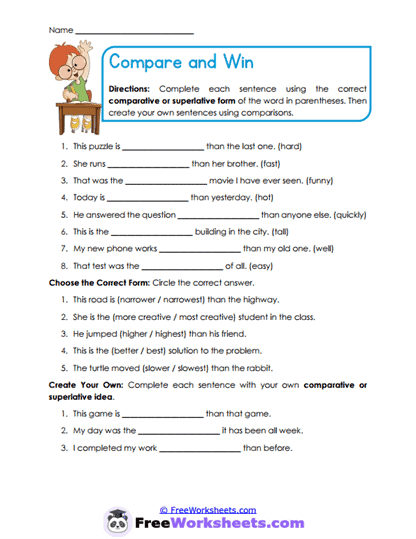
This Grade 7 Language Arts worksheet gives students practice with comparative and superlative adjectives and adverbs. Comparative forms compare two people, places, actions, or things, while superlative forms compare three or more. Students complete sentences, choose the correct form, and create original comparisons of their own. For example, “This puzzle is harder than the last one” compares two puzzles, while “That was the funniest movie of all” compares one movie with a larger group.
Learning Goals
The main goal is to help students choose comparison forms that match the meaning and number of items being compared. Students should already recognize common adjective and adverb forms. This activity moves them toward using endings such as “-er” and “-est” as well as words such as “more,” “most,” “better,” and “best.” It supports CCSS.ELA-LITERACY.L.7.1 and CCSS.ELA-LITERACY.L.7.3 through accurate grammar and effective sentence construction.
Student Tasks
On this worksheet, students will complete eight sentences using the correct comparative or superlative form of a word in parentheses. They will then circle the correct option in five additional comparison sentences. The final section asks students to create three original statements using their own comparative or superlative forms. This combination gives them guided practice, error recognition, and independent application.
Common Challenges
Students may use a superlative form when only two things are being compared. Others may create double comparisons such as “more faster” or “most easiest.” Irregular forms like “better,” “best,” “worse,” and “worst” can also be difficult to remember. Remind students to count how many items are involved before choosing the form.
Teaching Suggestions
A teacher can draw two objects for a comparative example and three objects for a superlative example. This simple visual makes the difference much easier to remember. At home, a parent can ask the child to compare two family meals and then name the best meal of the week. Using real examples helps the grammar feel practical instead of abstract.
Worksheet Features
The worksheet includes guided completion, multiple-choice correction, and original sentence writing. Examples use both adjectives and adverbs, so students practice several kinds of comparisons. The page also includes regular and irregular forms to create a balanced review. It works well for direct instruction, homework, small-group support, or a grammar assessment.