
About This Worksheet
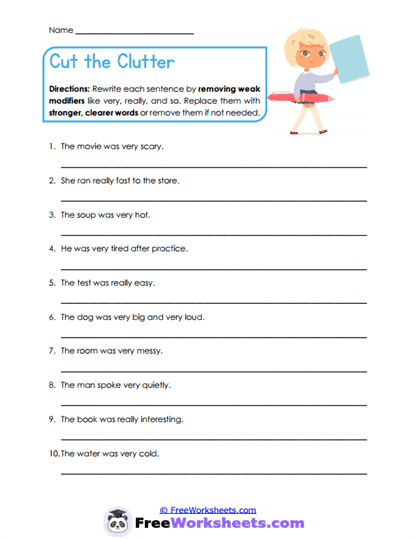
This Grade 7 Language Arts worksheet helps students replace weak modifiers with stronger and more exact language. The sentences rely on words such as “very,” “really,” and “so,” which often make writing sound vague or repetitive. Students revise each example by choosing a sharper adjective or adverb that communicates the meaning more clearly. For example, “The movie was very scary” can become “The movie was terrifying.”
Learning Goals
The main goal is to teach students that strong writing often uses one precise word instead of a weak word combination. Students should already understand that adjectives describe nouns and adverbs modify actions or descriptions. This activity moves them toward revising for clarity, word strength, and smoother style. It supports CCSS.ELA-LITERACY.L.7.3 and CCSS.ELA-LITERACY.L.7.6, which address effective language choices and accurate use of grade-level vocabulary.
Student Tasks
On this worksheet, students will rewrite ten sentences that contain weak modifiers. They must remove or replace words such as “very,” “really,” and “so” when those words do not add enough meaning. Each revision should sound clearer and more natural while keeping the original idea. The exercise encourages students to choose exact words such as “freezing,” “exhausted,” “effortless,” or “whispered.”
Common Challenges
Some students may simply replace “very” with another weak word instead of improving the sentence. Others may choose a stronger adjective that changes the original meaning too much. A student might also leave the weak modifier in place and add another description beside it. Encourage learners to read the sentence aloud and ask whether one exact word can do the work of two vague ones.
Teaching Suggestions
A teacher can build a quick class chart showing weak phrases beside stronger alternatives. Students may then compare answers and discuss why several revisions can be correct. At home, a parent can ask the child to explain what picture or feeling each stronger word creates. That conversation helps students understand that revision is about clearer meaning, not merely using longer vocabulary.
Worksheet Features
The page presents ten short sentences with enough writing space for complete revisions. Each example focuses on a familiar situation, so students can concentrate on word choice rather than difficult content. The directions allow students to remove unnecessary modifiers or replace them with stronger ones. This worksheet is useful for editing practice, vocabulary growth, independent work, or a writing mini-lesson.