
About This Worksheet
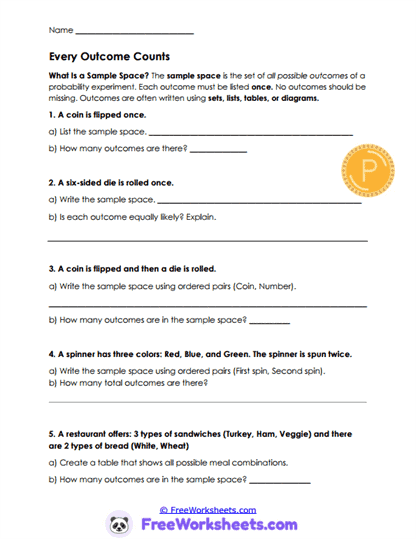
A sample space shows every possible outcome of a probability experiment. This worksheet helps students build sample spaces using coins, dice, spinners, and real-world combinations. Students organize outcomes using lists, tables, and ordered pairs to make sure no possibilities are missing. For example, flipping a coin and rolling a die creates ordered pairs such as (Heads, 3). The activity helps students understand how organized sample spaces support accurate probability calculations.
Curriculum and Grade Alignment
This worksheet supports Algebra 2 and high school probability standards involving sample spaces and counting outcomes. The main learning goal is to organize and count all possible outcomes of probability experiments. Students should already understand basic probability vocabulary before beginning. The next learning step is compound probability and probability simulations. This aligns with HSS-CP.A.1 because students describe sample spaces systematically.
Student Tasks
On this worksheet, students will write sample spaces for coins, dice, spinners, and meal combinations. They will organize outcomes using ordered pairs and tables and count the total number of possible outcomes. Students also determine whether outcomes are equally likely and explain reasoning. Several problems ask learners to organize compound sample spaces carefully.
Common Challenges and Misconceptions
Some students may leave outcomes out of the sample space accidentally. Others may repeat outcomes or organize ordered pairs incorrectly. A common mistake is forgetting that order matters in some probability experiments. Teachers can help by encouraging students to organize outcomes systematically instead of randomly listing them.
Implementation Guidance
This worksheet works well during lessons introducing compound sample spaces and organized counting methods. Teachers can model how to create tables or tree diagrams before assigning independent work. Parents helping at home can use coins, dice, or simple drawings to recreate the experiments physically. Those concrete examples often help students understand how outcomes combine.
Details and Features
The worksheet includes sample spaces for coins, dice, spinners, and real-world combination situations. Students practice ordered pairs, tables, and organized counting methods. The printable layout provides structured spaces for writing outcomes and totals clearly. The progression from simple to compound sample spaces helps students strengthen probability organization skills.