
About This Worksheet
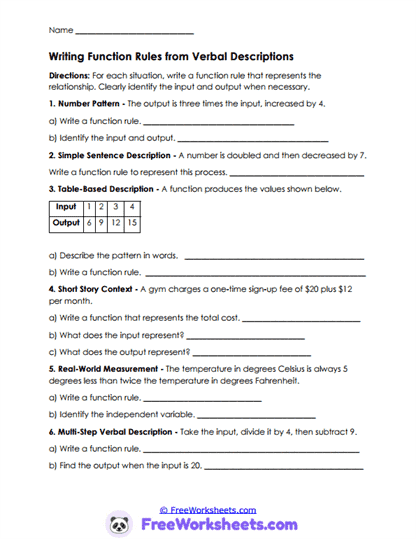
Functions can be written from verbal descriptions, patterns, tables, and real-world situations. This worksheet helps students turn words and numerical relationships into algebraic function rules. Students analyze patterns, identify inputs and outputs, and write equations that model each situation. For example, a gym membership fee can be represented using a fixed starting cost and a monthly charge. The activity helps students connect algebraic equations to meaningful real-world relationships.
Curriculum and Grade Alignment
This worksheet supports Algebra 2 standards involving writing and interpreting functions. The main learning goal is to create function rules from verbal descriptions and numerical patterns. Students should already understand basic algebra operations and function notation before beginning. The next learning step is graphing and comparing functions represented in different forms. This aligns with HSF-IF.A.1 because students build functions that model relationships between quantities.
Student Tasks
On this worksheet, students will write algebraic function rules based on verbal descriptions, tables, and real-world scenarios. They will identify independent and dependent variables and explain numerical patterns. Students also evaluate function rules for given inputs and describe relationships in words. Several problems ask learners to connect real-world meaning to algebraic equations.
Common Challenges and Misconceptions
Some students may reverse the input and output variables while writing equations. Others may overlook the starting value in real-world situations involving fixed costs. A common mistake is describing the pattern correctly in words but writing the algebraic rule incorrectly. Teachers can help by encouraging students to identify what changes and what stays constant before writing the rule.
Implementation Guidance
This worksheet works well during lessons on function modeling and algebraic reasoning. Teachers can model how to translate a verbal description into an equation before students work independently. Parents helping at home can ask students what the input and output represent in each situation. Those discussions often help students connect algebra to practical meaning.
Details and Features
The worksheet includes verbal descriptions, input-output tables, and real-world modeling situations. Students practice writing equations and identifying variables within functional relationships. The printable format provides organized answer spaces for equations and explanations. The variety of contexts helps students strengthen both algebra skills and function understanding.