
About This Worksheet
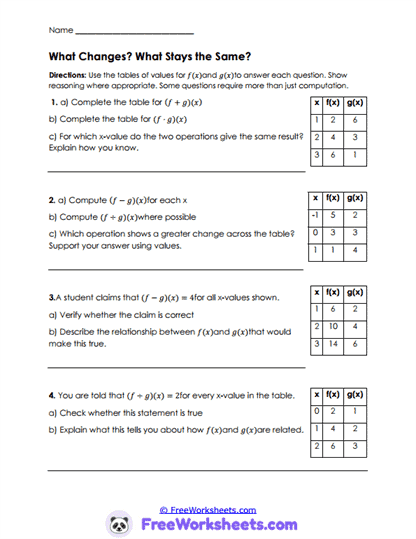
Function operations can reveal patterns and relationships between sets of values. This worksheet helps students compare how adding, subtracting, multiplying, and dividing functions change outputs within tables. Students study numerical patterns and explain how operations affect the results. For example, students may notice that subtraction creates constant differences across a table. The activity encourages students to think about relationships between functions instead of only performing calculations.
Curriculum and Grade Alignment
This worksheet supports Algebra 2 standards involving function operations and numerical reasoning. The main learning goal is to analyze how operations affect outputs in function tables. Students should already understand table interpretation and arithmetic operations with functions before beginning. The next learning step is studying transformations and relationships between families of functions. This aligns with HSF-BF.A.1 because students evaluate and interpret combined functions numerically.
Student Tasks
On this worksheet, students will complete function operation tables involving addition, subtraction, multiplication, and division. They will compare results across multiple x-values and explain observed patterns. Students also determine when two operations produce the same output and justify their reasoning. Several problems ask learners to explain relationships between f(x)f(x)f(x) and g(x)g(x)g(x) using table evidence.
Common Challenges and Misconceptions
Some students may focus only on calculation and overlook the patterns within the outputs. Others may mix up rows in the tables while computing operations. A common mistake is assuming two operations are always different without checking the values carefully. Teachers can help by encouraging students to describe what changes and what stays the same across the table.
Implementation Guidance
This worksheet works well during lessons on numerical reasoning and function relationships. Teachers can guide students through one table together before assigning independent practice. Parents helping at home can ask students to explain what pattern they notice in the outputs. Those conversations often help students think more deeply about function behavior and operations.
Details and Features
The worksheet includes multiple tables of values and comparison questions involving different function operations. Students practice analyzing patterns, comparing outputs, and supporting conclusions with evidence. The printable format provides organized spaces for calculations and written explanations. The table-based structure helps students strengthen both algebra skills and reasoning abilities.