
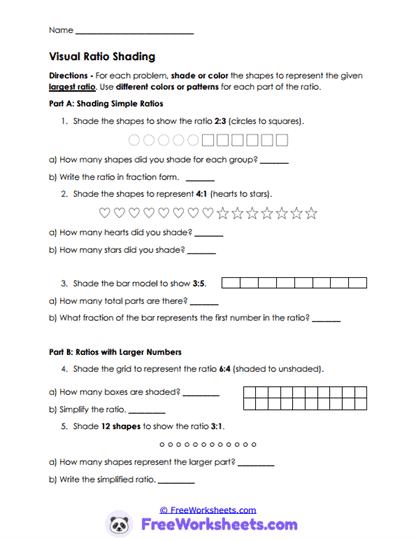
About This Worksheet
This worksheet helps students compare proportional relationships and identify situations that do or do not belong within a set. Learners analyze numerical relationships, visual models, unit rates, and equivalent fractions to determine patterns and inconsistencies. Students justify reasoning using mathematical evidence and proportional thinking. For example, students compare speeds, equivalent fractions, and visual representations to identify which example differs from the others. This activity strengthens analytical thinking and conceptual understanding of proportional relationships.
Curriculum and Grade Alignment
This worksheet focuses on comparing proportional relationships, identifying equivalent relationships, and explaining mathematical reasoning. Students should already understand equivalent fractions, unit rates, and proportional comparisons before beginning this activity. The primary learning goal is helping learners analyze relationships critically and justify conclusions mathematically. After mastering these skills, students are better prepared for algebraic reasoning, graph analysis, and mathematical argumentation. The worksheet aligns with Common Core standards 7.RP.A.1 and 7.RP.A.2, along with TEKS 7.4A involving proportional relationships and reasoning.
Student Tasks
On this worksheet, students will
analyze groups of numerical relationships, visual models, equivalent fractions, and real-world rate examples to determine which item does not belong. Students explain reasoning using proportional relationships and mathematical comparisons. Learners identify unit rates and compare equivalent values across multiple representations. Several activities encourage students to justify more than one possible correct answer when mathematically valid. Students also practice communicating reasoning clearly using mathematical vocabulary.
Common Challenges and Misconceptions
Some students may focus only on appearance instead of mathematical relationships. Others can struggle explaining reasoning even when answers are correct. Learners sometimes confuse equivalent fractions with proportional comparisons involving rates. Students may also overlook units while comparing real-world examples. Teachers can support understanding by modeling how to justify answers using mathematical evidence.
Implementation Guidance
Teachers may use this worksheet during proportional reasoning lessons, review discussions, or enrichment activities. The open-ended reasoning format encourages mathematical communication and critical thinking. Parents and homeschool educators can complete one example together before independent work begins. Students often benefit from discussing multiple possible answers in pairs or groups. This worksheet also works well for math talks, intervention practice, or classroom discussions.
Details and Features
This printable worksheet includes comparison activities requiring mathematical reasoning and explanation. The organized layout supports analytical thinking and written justification. Mixed representations encourage students to connect visual, numerical, and real-world proportional relationships. Problems are designed to strengthen conceptual understanding and reasoning skills. The worksheet prints clearly for classroom instruction, tutoring support, or homeschool learning.