
About This Worksheet
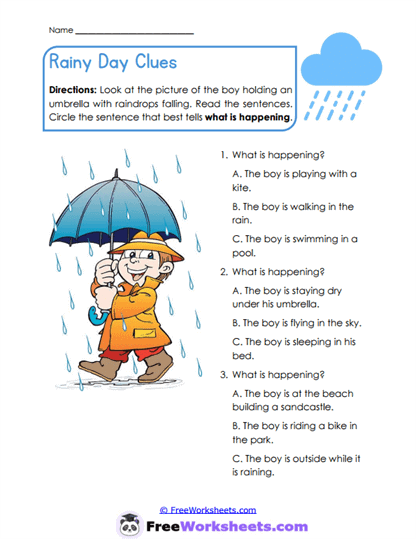
An inference is when students use clues from pictures or text to figure out what is happening, even if it is not directly stated. This Kindergarten worksheet focuses on using visual clues to understand a situation. Students study a picture and choose the sentence that best explains what is going on. For example, rain becomes walking in the rain when students connect the umbrella and raindrops to the correct idea.
Curriculum and Grade Alignment
This worksheet is perfect for Kindergarten students who are beginning to think beyond what they see and make simple inferences. The main goal is to help learners connect visual details with meaning. Students should already be comfortable identifying basic objects and actions in pictures. It aligns with Common Core Standard RL.K.1 and supports TEKS ELAR K.6.B for making inferences using evidence.
Student Tasks
On this worksheet, students will look closely at a picture of a boy holding an umbrella in the rain. They will read each question and choose the answer that best describes what is happening. Students must use clues from the image to guide their thinking. This helps them practice connecting details to meaning.
Common Challenges and Misconceptions
Some students may choose answers based on guessing instead of looking carefully at the picture. Others might focus on one detail and miss the bigger idea. A few learners may struggle to read the answer choices independently. Teachers can support students by modeling how to look for clues and talk through the reasoning.
Implementation Guidance
Teachers can use this worksheet during reading comprehension lessons focused on inference skills. It works well in small groups where students can discuss what they notice in the picture. Parents can use it at home by asking questions like “What do you see?” and “What does that tell you?” Keeping the conversation going helps build thinking skills.
Details and Features
This worksheet includes a clear, engaging picture paired with simple multiple-choice questions. The format supports early readers with structured answer choices. It encourages observation, thinking, and decision-making. The printable design makes it easy to use in any learning setting.