
About This Worksheet
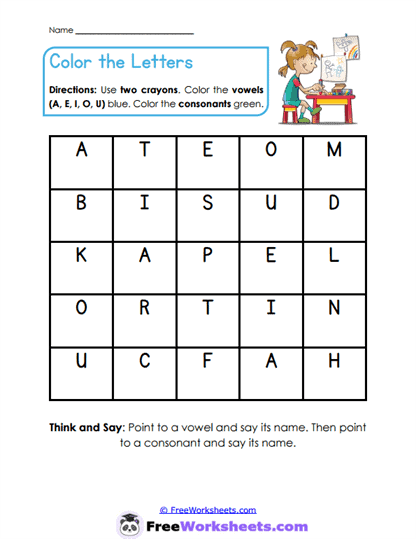
A vowel is a letter that creates an open sound, while a consonant involves some closure in the mouth when spoken. This Kindergarten worksheet focuses on identifying vowels and consonants through color coding. Students visually distinguish between the two types of letters by applying different colors. For example, A becomes a vowel when colored blue according to the directions.
Curriculum and Grade Alignment
This worksheet is intended for Kindergarten students developing early phonics and letter recognition skills. The main objective is to help learners quickly identify vowels and consonants in a group of letters. Students should already know letter names before completing this activity, and this supports early reading development. It aligns with Common Core Standard RF.K.3 and supports TEKS ELAR K.2.A for letter identification and classification.
Student Tasks
On this worksheet, students will use two crayons to color vowels and consonants in different colors. They will scan a grid of letters and identify which ones belong to each group. Learners also complete a follow-up activity by pointing to and naming vowels and consonants. This reinforces both visual and verbal recognition.
Common Challenges and Misconceptions
Students may forget which letters are vowels and accidentally color them incorrectly. Some learners might rush and miss letters in the grid. Others may confuse similar-looking letters if they are still developing recognition skills. Teachers can support students by reviewing vowel letters and checking work together.
Implementation Guidance
Teachers can use this worksheet as a fun, engaging activity during phonics lessons. It works well for independent practice or as part of a literacy center. Parents can use it at home by guiding children through the coloring directions and discussing each letter. Encouraging students to say the letters aloud will reinforce learning.
Details and Features
This worksheet includes a clear letter grid and simple color directions for easy understanding. The activity combines visual learning with phonics practice. It is designed to be engaging and interactive for young learners. The printable format makes it ideal for classroom or at-home use.