
About This Worksheet
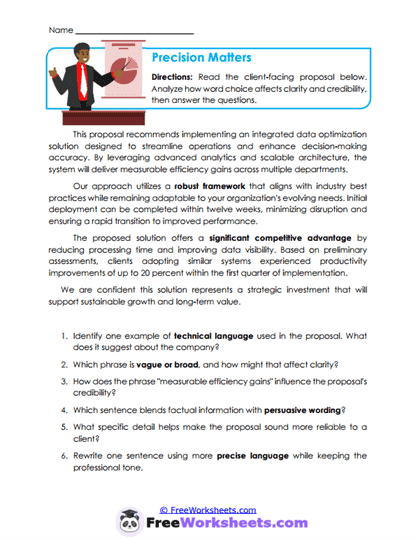
This worksheet is about analyzing word choice, which means understanding how specific language affects clarity and credibility. It is designed for Grade 11 students reading business proposals. Students learn how precise words make writing stronger and more trustworthy. For example, “measurable efficiency gains” becomes clearer than vague language like “better results.” This helps students improve both reading and writing skills.
Curriculum and Grade Alignment
This worksheet supports Grade 11 standards focused on language and clarity. The main goal is helping students evaluate how word choice affects meaning. Students should already understand basic sentence structure. After this, they will revise their own writing for clarity. It aligns with Common Core RI.11-12.4 and W.11-12.5, along with TEKS ELA.11.11B.
Student Tasks
On this worksheet, students will read a business proposal. They identify examples of technical language. Students find phrases that are vague or unclear. They analyze how word choice affects credibility. In the final step, they rewrite a sentence using more precise language.
Common Challenges and Misconceptions
Students may think longer words always improve clarity. Some might struggle to identify vague phrases. Others may find it difficult to rewrite sentences effectively. It can also be hard to explain why precision matters. Teachers can help by modeling clear and unclear examples.
Implementation Guidance
Teachers can use this worksheet during writing and editing lessons. It works well for improving professional communication skills. Parents can support by discussing clear versus unclear language. This worksheet is useful for career readiness. It can be used as guided or independent practice.
Details and Features
The worksheet includes a realistic proposal with varied language use. Questions guide students through analyzing and improving clarity. The layout is simple and easy to follow. It is printable and ready for use. The activity strengthens both reading and writing skills.