
About This Worksheet
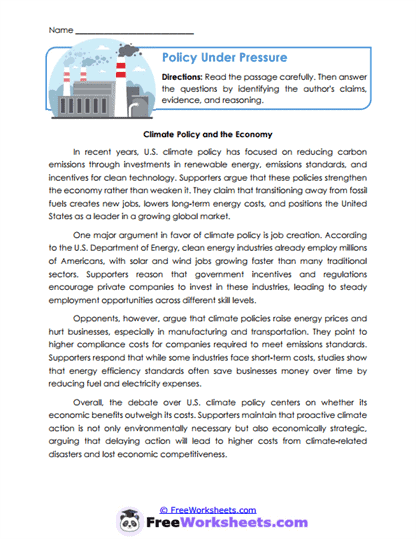
This worksheet is about analyzing claims, evidence, and reasoning, which means understanding how an author builds an argument. It is designed for Grade 11 students reading informational texts about real-world issues. Students learn how to identify what the author is arguing and how they support it. For example, “climate policy creates jobs” is a claim, while “data from energy reports” is evidence. This helps students evaluate how strong an argument really is.
Curriculum and Grade Alignment
This worksheet supports Grade 11 standards focused on evaluating arguments and evidence. The main goal is helping students break down how claims are supported in a text. Students should already know how to find main ideas and details. After this, they will write their own arguments using strong reasoning. It aligns with Common Core RI.11-12.8 and TEKS ELA.11.9E.
Student Tasks
On this worksheet, students will read a passage about climate policy and the economy. They identify the author’s main claims in the text. Students also find supporting evidence and explain how it connects to the claims. They analyze the reasoning used to link ideas together. In the final step, they evaluate how convincing the argument is.
Common Challenges and Misconceptions
Students may confuse evidence with opinions if they are not careful. Some might identify claims but not explain how they are supported. Others may struggle to see how reasoning connects ideas. It can also be hard to judge whether evidence is strong or weak. Teachers can help by modeling how to connect claims and evidence clearly.
Implementation Guidance
Teachers can use this worksheet during units on argument and persuasive writing. It works well for class discussions about real-world topics. Parents can support learning by asking their child to explain the author’s main point. This worksheet is also helpful for preparing for standardized tests. It can be used as practice or review.
Details and Features
The worksheet includes a current and engaging topic about climate policy. Questions are structured to guide students through each part of an argument. The layout is clean and easy to use. It is printable and flexible for different learning settings. The activity supports both comprehension and critical thinking.