
About This Worksheet
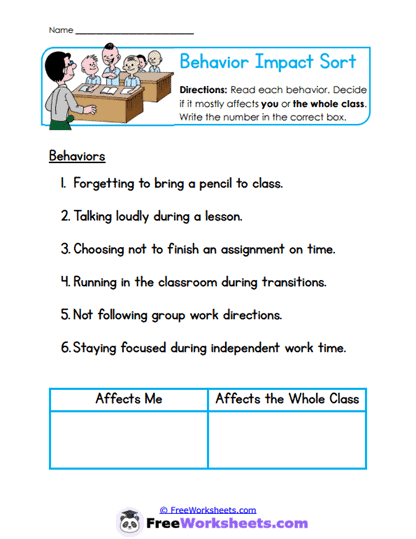
This worksheet is a behavior classification activity designed to help students evaluate how their actions affect themselves and others. It focuses on distinguishing between behaviors that primarily impact an individual and those that influence the entire class. Created for kindergarten through second grade learners, it strengthens social awareness and responsibility within a classroom setting. Students analyze common school behaviors and determine who is affected by each action. For example, “Talking loudly during a lesson” affects the whole class, while “Forgetting to bring a pencil” mostly affects the individual student. This sorting structure reinforces accountability and helps students understand the broader consequences of their choices.
Curriculum and Grade Alignment
This worksheet aligns with early elementary SEL standards emphasizing social awareness and responsible decision-making. The primary learning objective is to help students recognize how personal behavior contributes to classroom climate and productivity. Students should already understand basic classroom expectations before completing this activity. The content supports Common Core Speaking and Listening Standards SL.K.1 and SL.1.1 by reinforcing appropriate participation behaviors. It also aligns with CASEL competencies in self-awareness and relationship skills. This resource promotes thoughtful reflection on how actions influence both individuals and groups.
Student Tasks
On this worksheet, students will read a list of classroom behaviors presented in numbered form. They determine whether each behavior mostly affects themselves or the entire class. Students write the corresponding behavior number in the correct sorting box labeled “Affects Me” or “Affects the Whole Class.” Careful reading and reasoning are required to categorize each behavior accurately. Learners must consider both academic and social consequences. The task strengthens classification skills and promotes accountability.
Common Challenges and Misconceptions
Students may assume that all behaviors affect everyone equally. Some learners might focus only on immediate consequences without considering broader classroom impact. Others may struggle with behaviors that indirectly influence peers. Confusion can arise when actions have both personal and group effects. Younger students may need clarification on what “affects the whole class” truly means. Teachers can guide discussion by asking students to explain why they placed each behavior in a specific category.
Implementation Guidance
Teachers can use this worksheet during classroom meetings focused on community responsibility. It works well as a discussion-based activity that encourages students to justify their choices. Small-group collaboration promotes deeper understanding of shared classroom expectations. Parents and homeschool educators may use this activity to discuss how behaviors influence family or group environments. Reviewing classroom norms before completing the sort enhances clarity. This worksheet also serves as a reflective formative assessment of behavior awareness.
Details and Features
The worksheet includes clearly labeled sorting boxes for organized responses. Behavior statements are written in developmentally appropriate language for early elementary students. The layout supports easy reading and structured categorization. The black-and-white printable format allows for convenient classroom copying. Adequate space is provided for writing behavior numbers clearly. Its simple design encourages thoughtful participation without distraction.