
About This Worksheet
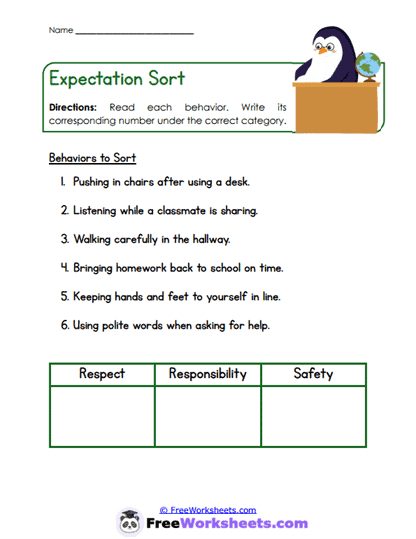
This worksheet is a behavior categorization activity designed to help students sort classroom behaviors into expectation categories. It focuses on identifying actions that reflect respect, responsibility, or safety within the school environment. Intended for kindergarten through second grade learners, it strengthens social-emotional awareness and decision-making skills. Students analyze short behavior descriptions and determine which expectation category they belong to. For example, “Walking carefully in the hallway” becomes Safety. This sorting format reinforces students’ ability to classify behaviors based on shared characteristics.
Curriculum and Grade Alignment
This worksheet aligns with early elementary SEL competencies related to social awareness and responsible decision-making. The primary learning goal is helping students differentiate between types of positive behaviors. Students should already be familiar with the concepts of respect, responsibility, and safety before completing this task. The activity supports Common Core Speaking and Listening Standard SL.K.1 and SL.1.1 by reinforcing participation norms. It also aligns with CASEL competencies in social awareness and relationship skills. This resource builds foundational categorization and reasoning skills.
Student Tasks
On this worksheet, students will read a list of classroom behaviors to sort. They identify whether each behavior demonstrates respect, responsibility, or safety. Students write the corresponding behavior number under the correct category box. Careful reading and interpretation are required to ensure accurate placement. Learners must analyze the intent behind each action rather than relying on keywords alone. The task strengthens critical thinking and classification skills.
Common Challenges and Misconceptions
Students may confuse similar categories such as respect and responsibility. Some learners might place behaviors based on a single word rather than understanding the full meaning. Others may struggle to recognize that some behaviors support multiple expectations but must choose the best fit. Young students may require clarification of abstract terms like “responsibility.” Additionally, rushing through the sort can lead to incorrect categorization. Teachers can review category definitions and model sorting one example together before independent work.
Implementation Guidance
Teachers can use this worksheet during classroom meetings focused on reviewing school-wide expectations. It works well as a small-group activity that encourages discussion and reasoning. Students benefit from explaining why a behavior fits a specific category. Parents and homeschool educators may use this worksheet to reinforce household expectations using similar categories. Pre-teaching vocabulary improves student confidence and accuracy. This activity also serves as a formative assessment of behavior understanding.
Details and Features
The worksheet includes clearly labeled category boxes for Respect, Responsibility, and Safety. Behavior statements are written in developmentally appropriate language. The layout supports easy sorting and organized responses. The black-and-white printable format ensures classroom-friendly copying. Visual spacing enhances readability and focus. Its structured design promotes both discussion and independent work.