
Worksheet Overview
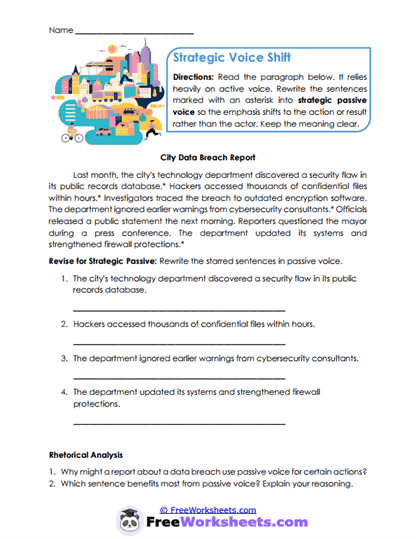
Strategic Voice teaches students that effective writers intentionally choose between active and passive voice based on what they want readers to notice. Students analyze a news report about a cybersecurity breach before rewriting selected sentences in passive voice to shift the emphasis from the actor to the action or result. Rather than treating passive voice as something to avoid, they learn how journalists, scientists, and technical writers use it strategically. This activity connects grammar directly to rhetorical decision-making.
Why Students Will Love This Worksheet
Students enjoy comparing the original and revised versions because they can immediately see how passive voice changes the focus of the story. The cybersecurity topic feels current and realistic, helping students understand how grammar choices influence news reporting. The reflection questions also encourage thoughtful discussion about why professional writers sometimes hide or emphasize the person performing an action. This makes grammar feel purposeful instead of mechanical.
What Students Will Practice
Students rewrite active voice sentences into passive voice while preserving the original meaning of a realistic informational passage. After completing the revisions, they analyze how passive voice shifts emphasis and explain why a journalist or technical writer might prefer that construction. Throughout the worksheet, students strengthen grammar, revision, rhetorical analysis, and informational writing skills. Every activity reinforces purposeful voice selection instead of automatic editing.
Why This Skill Matters
Professional writers choose active and passive voice based on audience, purpose, and the information they want readers to focus on. Students who understand these choices become stronger writers because they can control emphasis more effectively in essays, research papers, news articles, and laboratory reports. These rhetorical skills also improve reading comprehension by helping students recognize an author’s writing decisions. Mastering voice prepares students for college writing across multiple disciplines.
How You Can Use This Worksheet
Teachers can use this worksheet during units on active and passive voice, journalism, technical writing, or rhetorical analysis. It works especially well after students have learned both voice constructions because they apply grammar within an authentic informational text. Parents and homeschool educators can compare the active and passive versions together, discussing how the emphasis changes in each sentence. The worksheet also provides excellent preparation for research writing and advanced composition.
What’s Included
This printable Grade 11 grammar worksheet features an authentic news-style passage followed by guided voice revisions and rhetorical analysis questions. Students rewrite active sentences into passive voice before explaining how each revision changes the focus of the writing. The engaging real-world context reinforces advanced grammar alongside purposeful writing decisions. The printer-friendly layout includes generous writing space for classroom instruction, tutoring, homework, or homeschool learning.