
About This Worksheet
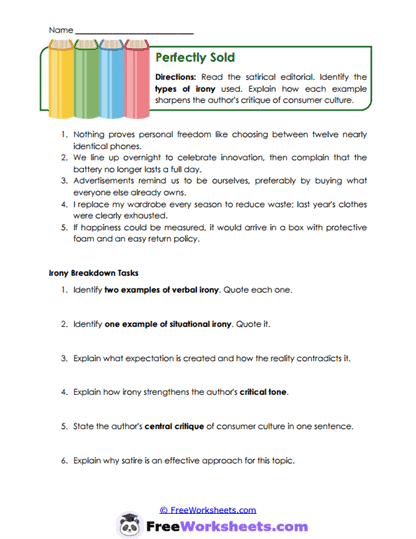
This worksheet is about irony and satire, which means understanding how authors use humor or contradiction to make a point. It is designed for Grade 11 students analyzing persuasive or editorial writing. Students learn how statements can mean the opposite of what they say to criticize an idea. For example, “buying what we already own” becomes a way to point out consumer habits. This helps students recognize deeper messages in writing.
Curriculum and Grade Alignment
This worksheet supports Grade 11 standards focused on analyzing author’s craft and tone. The main goal is helping students identify different types of irony and understand their purpose. Students should already know basic figurative language. After this, they will evaluate how tone shapes meaning. It aligns with Common Core RL.11-12.4 and TEKS ELA.11.9D.
Student Tasks
On this worksheet, students will read a satirical editorial. They identify examples of verbal and situational irony. Students quote lines that show each type. They explain how expectations are created and then contradicted. In the final step, they analyze how irony strengthens the author’s critique.
Common Challenges and Misconceptions
Students may confuse irony with simple humor. Some might identify examples but not explain their meaning. Others may struggle to understand satire’s purpose. It can also be difficult to explain how tone contributes to criticism. Teachers can help by modeling examples of irony in everyday situations.
Implementation Guidance
Teachers can use this worksheet during lessons on satire and tone. It works well as a discussion-based activity. Parents can support by pointing out examples of irony in media. This worksheet builds deeper thinking skills. It can be used as guided or independent practice.
Details and Features
The worksheet includes a short editorial with clear examples of irony. Questions guide students step by step through analysis. The layout is clean and easy to follow. It is printable and ready for use. The activity supports comprehension and interpretation.