
About This Worksheet
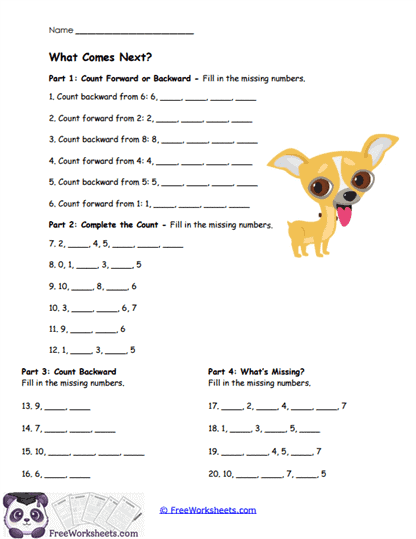
This worksheet is a Kindergarten counting activity that helps students practice counting forward and backward while filling in missing numbers. Children complete counting sequences by identifying which numbers come next, before, or after within patterns up to 10. The activity strengthens number sequencing, counting fluency, and early problem-solving skills through a variety of counting exercises. For example, counting forward from 4 continues as 5, 6, 7, while counting backward from 8 continues as 7, 6, 5. The multiple sections and repeated practice help young learners become more comfortable working with number patterns.
Curriculum and Grade Alignment
This worksheet is designed for Kindergarten students learning how to count forward and backward within 10. The primary learning goal is helping children recognize number order and complete counting sequences accurately. Students should already know how to recognize numbers from 0-10 before beginning the activity. These foundational counting skills prepare learners for future work with addition, subtraction, and number line strategies in first grade. This worksheet supports Common Core Standard K.CC.A.1 and aligns with TEKS K.2.A for counting forward and backward to represent numbers.
Student Tasks
On this worksheet, students will fill in missing numbers while completing forward and backward counting patterns. Children analyze each sequence carefully before deciding which numbers belong in the blanks. Learners practice counting up and counting down while strengthening number recognition and sequencing fluency. Students also improve problem-solving skills by identifying patterns within different counting exercises. The multiple activity sections give children repeated opportunities to practice counting concepts in different ways.
Common Challenges and Misconceptions
Some students may confuse forward counting with backward counting when switching between sections of the worksheet. Young learners sometimes skip numbers because they move too quickly through the patterns. A few children may struggle to identify missing middle numbers within longer sequences. Students who are still building number recognition skills may also reverse numerals while writing answers. Teachers and parents can help by encouraging children to count aloud slowly before filling in the blanks.
Implementation Guidance
Teachers can use this worksheet during guided math lessons, independent practice, or review activities focused on number sequencing. Parents may find the varied sections useful because they provide different types of counting practice in one activity. Students can use number lines, counters, or fingers to track the counting sequences before writing answers. This worksheet also works well for small-group discussions where children explain how they found the missing numbers. Adults should encourage learners to reread each sequence after completing it to check for accuracy.
Details and Features
This printable worksheet includes several forward and backward counting activities using numbers up to 10. Clear spacing and organized sections help Kindergarten students focus on one counting pattern at a time. The black-and-white design prints clearly for classroom packets, homework assignments, or homeschool lessons. Fun illustrations and beginner-friendly directions support young learners who are still developing independent work habits. Its structured layout makes the worksheet useful for review practice, intervention, or early counting assessments.