
About This Worksheet
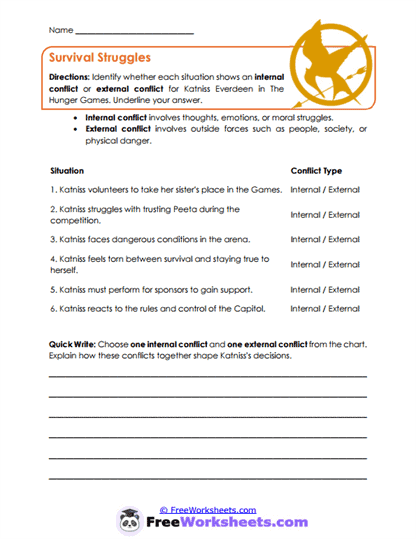
This worksheet is a reading analysis activity focused on identifying types of conflict in a story. It is designed for 9th-grade students studying The Hunger Games. Students learn the difference between internal and external conflict. The worksheet provides examples from the novel for students to classify. For example, fear becomes an internal conflict, while danger in the arena becomes external conflict.
Curriculum and Grade Alignment
This worksheet aligns with Grade 9 literature standards for analyzing character development and conflict. The main goal is to help students understand how different types of conflict affect a story. Students should already know basic story elements. This skill prepares them for deeper character analysis. It connects to CCSS.ELA-LITERACY.RL.9-10.3, which focuses on character and conflict development.
Student Tasks
On this worksheet, students will read different situations from the novel. They will decide whether each situation shows internal or external conflict. Students must think about whether the struggle is inside the character or caused by outside forces. They then complete a short writing task explaining how both types of conflict shape decisions. This builds both understanding and writing skills.
Common Challenges and Misconceptions
Students may confuse internal and external conflict, especially when both are present. Some might focus only on actions and not emotions. Others may struggle to explain how conflict affects decisions. It can also be difficult to choose the best category for complex situations. Teachers can help by reviewing clear examples of each type.
Implementation Guidance
Teachers can use this worksheet during a lesson on conflict in literature. It works well as practice before writing about character development. Parents can use it at home to support reading discussions. This worksheet is also useful for review. It strengthens understanding of key literary concepts.
Details and Features
The worksheet includes clear examples from a well-known novel. It provides structured choices for classifying conflict. There is also a short writing section for deeper thinking. The layout is simple and easy to print. It supports both reading and analysis skills.