
About This Worksheet
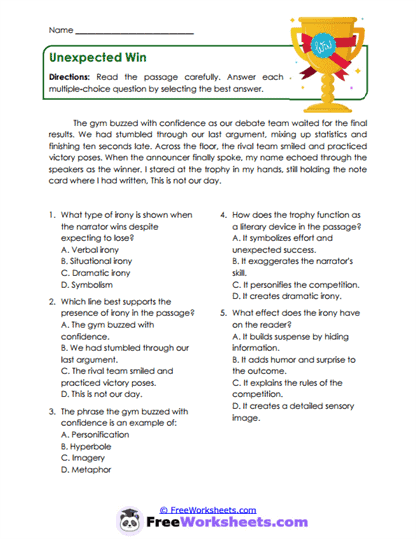
This worksheet is about analyzing literary devices through multiple-choice questions. It helps students understand irony, symbolism, and imagery in context. The subject is reading comprehension for Grade 9. Students learn how authors create meaning through storytelling choices. For example, winning when expecting to lose shows situational irony.
Curriculum and Grade Alignment
This worksheet supports Grade 9 reading analysis skills. The goal is to identify devices and understand their purpose in a passage. Students should already know basic literary terms. It aligns with CCSS.ELA-LITERACY.RL.9-10.4 and RL.9-10.3. It also connects to TEKS 9.5 and 9.7.
Student Tasks
On this worksheet, students will read a passage and answer multiple-choice questions. They will identify types of irony and other devices. Students must choose the best answer based on evidence from the text. Each question requires careful reading and thinking. They will practice test-style reasoning skills.
Common Challenges and Misconceptions
Students may confuse types of irony or choose answers too quickly. Some may rely on guessing instead of evidence. Others may misunderstand the passage’s tone. It can be tricky to connect a device to its purpose. Teachers should remind students to reread before answering.
Implementation Guidance
This worksheet is great for test prep or review lessons. Teachers can use it as independent practice or a quiz. Parents can use it to help students prepare for exams. It also works well for timed practice. This builds confidence with multiple-choice formats.
Details and Features
The worksheet includes a short engaging passage. Questions are clear and aligned to standards. The format mirrors standardized tests. It is easy to print and use. It supports both classroom and home learning.