
About This Worksheet
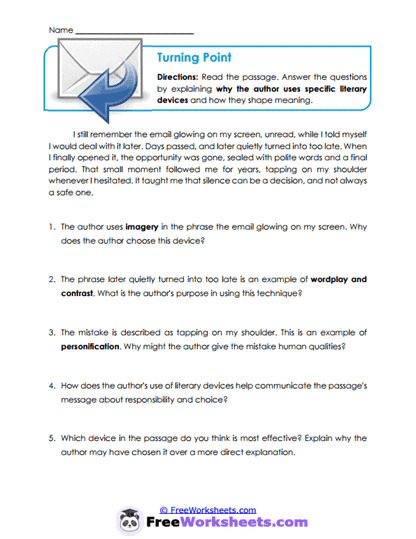
This worksheet focuses on helping students explain why authors use certain literary devices, not just identify them. It encourages deeper thinking about how writing choices affect meaning and message. Students will look at devices like imagery, contrast, and personification and think about how they shape the reader’s understanding. This is an important Grade 9 skill because students are expected to explain their thinking clearly in writing. For example, describing a mistake as “tapping on my shoulder” gives it human qualities and makes it feel more real.
Curriculum and Grade Alignment
This worksheet is built for 9th grade students working on higher-level reading and writing skills. The goal is to help students connect literary devices to the overall meaning or message of a passage. Students should already be able to recognize basic devices before moving into this level of explanation. This aligns with Common Core Standard CCSS.ELA-LITERACY.RL.9-10.2 and RL.9-10.4, focusing on theme and language use. It also supports TEKS 9.6 and 9.7, where students analyze how authors develop ideas.
Student Tasks
On this worksheet, students will read a reflective passage about a missed opportunity and its lasting impact. They will answer open-ended questions that ask them to explain why the author used certain literary devices. Students must think carefully and write complete answers that show their reasoning. They will connect specific phrases in the text to larger ideas like regret or decision-making. This builds both reading comprehension and writing skills at the same time.
Common Challenges and Misconceptions
Students often find it easier to name a literary device than to explain why it was used. Some may give very short answers that don’t fully explain their thinking. Others may struggle to connect the device to the bigger message of the passage. It can also be difficult for students to put their ideas into clear sentences. A helpful strategy is to encourage students to use sentence starters like “The author uses this to show…” or “This helps the reader understand…”
Implementation Guidance
Teachers can use this worksheet after modeling how to analyze literary devices in class. It works well as independent practice or as part of a writing-focused lesson. Students can also benefit from sharing their answers and hearing different perspectives. At home, parents can support by simply asking their child to explain their answers out loud. This helps students organize their thoughts and build confidence in their explanations.
Details and Features
The worksheet includes a meaningful passage that encourages reflection and deeper thinking. Questions are open-ended, allowing students to show what they truly understand. There is enough space for written responses, making it suitable for extended answers. The format is clean and easy to follow. It is designed for easy printing and flexible use in different learning environments.