
About This Worksheet
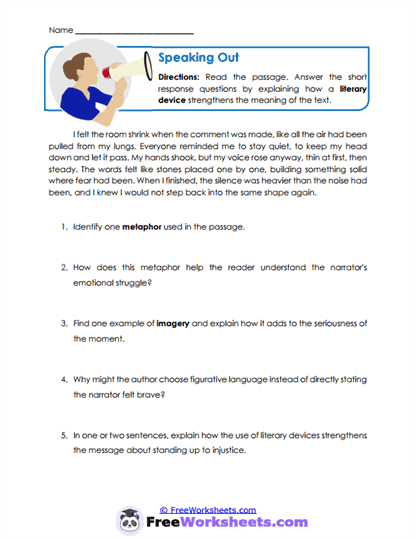
This worksheet focuses on how literary devices help show strong emotions in a story. It teaches students how writers use tools like metaphor and imagery to help readers feel what the character is going through. Your child will read a passage about someone finding the courage to speak up, which is something many students can relate to. This is an important Grade 9 skill because students need to explain how writing creates meaning, not just summarize it. For example, saying a voice was “pulled from my lungs” is a metaphor that shows how hard it was to speak.
Curriculum and Grade Alignment
This worksheet is designed for Grade 9 students who are building deeper reading and analysis skills. The main goal is to help students identify literary devices and explain how they affect meaning and emotion. Students should already know basic terms like metaphor and imagery before starting. This aligns with Common Core Standard CCSS.ELA-LITERACY.RL.9-10.4, which focuses on analyzing word choice and figurative language. It also supports TEKS 9.5, where students study how authors use language to influence readers.
Student Tasks
On this worksheet, students will read a personal narrative about speaking up in a difficult moment. They will identify a metaphor used in the passage and explain what it means. Students will also find an example of imagery and describe how it adds to the seriousness of the situation. They will answer several short-response questions that require clear thinking and complete sentences. This helps them practice both understanding and explaining literary techniques.
Common Challenges and Misconceptions
Students may be able to find a metaphor but struggle to explain what it really means. Some may give answers that are too short or unclear. Others might miss how imagery adds emotion to the scene. It can also be difficult to explain feelings in words, especially when the moment is intense. A helpful strategy is to ask students, “What does this line help you picture or feel?”
Implementation Guidance
Teachers can use this worksheet after a lesson on figurative language and emotional writing. It works well as independent practice or as part of a class discussion. Students can benefit from sharing their answers and hearing different ideas. At home, parents can support by asking their child to explain their answers out loud. This builds confidence and strengthens understanding.
Details and Features
This worksheet includes a relatable passage that connects to real-life experiences. The questions are focused and guide students toward deeper thinking. There is space for written responses in complete sentences. The layout is clean and easy to follow. It prints clearly and works well in both classroom and home settings.