
About This Worksheet
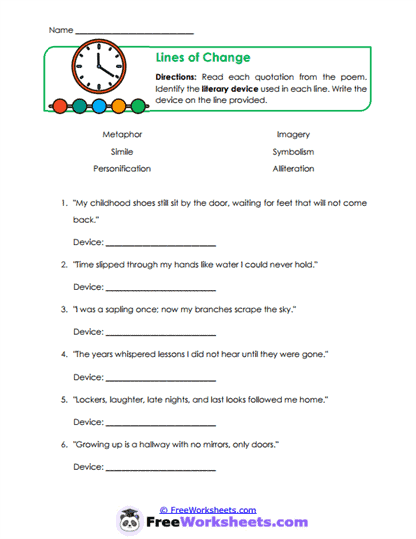
This worksheet gives students practice identifying literary devices in short, meaningful lines that feel like poetry. It helps them recognize patterns in language quickly and accurately. Your child will look for devices like metaphor, simile, alliteration, and symbolism in each line. This is a key Grade 9 skill because students need to recognize these devices in all types of texts, not just long passages. For example, “time slipped through my hands like water” is a simile showing how quickly time passes.
Curriculum and Grade Alignment
This worksheet is designed for Grade 9 students building fluency in identifying literary devices. The goal is to strengthen recognition so students can later explain meaning more easily. Students should already know basic definitions of the listed devices before starting. This aligns with Common Core Standard CCSS.ELA-LITERACY.RL.9-10.4, focusing on understanding figurative language. It also connects to TEKS 9.5, where students analyze how authors use language techniques.
Student Tasks
On this worksheet, students will read several short lines and determine which literary device is being used in each one. They will choose from a provided list and write their answers on the lines. Each sentence requires careful thinking, even though it is short. Students must focus on how the words are being used, not just what they say. This helps build quick recognition skills that support deeper analysis later.
Common Challenges and Misconceptions
Students may rush because the lines are short and assume the answers are easy. Some may confuse similar devices, especially metaphor and simile. Others may overlook clues like repeated sounds that signal alliteration. It can also be tricky when a line feels emotional but the student must name the device, not the feeling. A helpful reminder is to have students ask, “What is the writer doing with the words here?”
Implementation Guidance
Teachers can use this worksheet as a warm-up, review, or quick practice activity. It works well at the beginning of a lesson to get students thinking about language. At home, parents can support by having their child explain why they chose each answer. This builds confidence and reinforces understanding. It’s also a great tool for preparing for quizzes on literary devices.
Details and Features
The worksheet includes a clear list of literary devices for students to reference. The short lines are engaging and thought-provoking without being overwhelming. The layout is clean and easy to navigate. There is enough space for students to write their answers clearly. It is simple to print and use in any learning setting.