
About This Worksheet
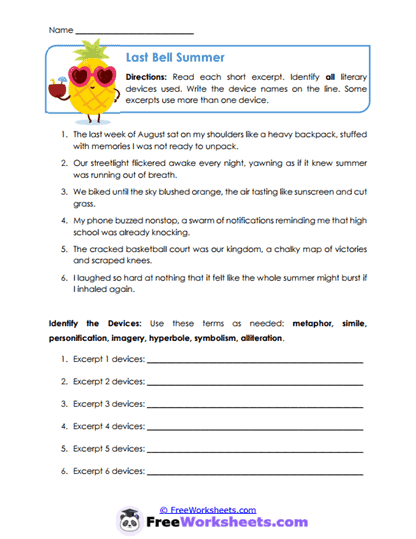
This worksheet is about literary devices, which are tools authors use to make writing more vivid and meaningful. It focuses on helping students recognize devices like metaphor, simile, and personification in short excerpts. The subject is reading and language arts for about 9th grade students. It builds understanding by asking students to look closely at how words create meaning. For example, “summer sat on my shoulders” becomes a metaphor showing feeling instead of a real action.
Curriculum and Grade Alignment
This activity is designed for Grade 9 students working on analyzing figurative language in texts. The main goal is to help students identify and name literary devices in context. Students should already understand basic definitions of common devices before starting. This connects to Common Core standard CCSS.ELA-LITERACY.RL.9-10.4, which focuses on analyzing word choice and meaning. In Texas, it aligns with TEKS 9.5, which asks students to analyze how language creates meaning.
Student Tasks
On this worksheet, students will read several short excerpts and identify the literary devices used in each one. They will write the names of the devices on the lines provided. Some excerpts may include more than one device, so careful reading is needed. Students must think about how the words are being used, not just what they say. They will practice labeling terms like imagery, metaphor, and symbolism.
Common Challenges and Misconceptions
Students often confuse similar devices like metaphor and simile because both compare things. Some may miss multiple devices in one sentence if they read too quickly. Others may focus on literal meaning instead of figurative meaning. It can also be hard for students to recognize less obvious devices like alliteration. Teachers should encourage students to slow down and look for clues like “like” or “as,” or human traits given to objects.
Implementation Guidance
Teachers can use this worksheet as a guided practice after introducing literary devices. It works well in small groups where students can talk through their thinking. Parents can use it at home to review key reading skills and build confidence. This activity also fits nicely as a warm-up or exit ticket. It helps reinforce skills students will need for deeper literary analysis.
Details and Features
The worksheet includes clearly written directions and multiple short excerpts for practice. It is formatted for easy printing and student use. There is space for students to write their answers neatly. The design is simple and focused to reduce distractions. It can be used as a standalone activity or part of a larger unit.