
About This Worksheet
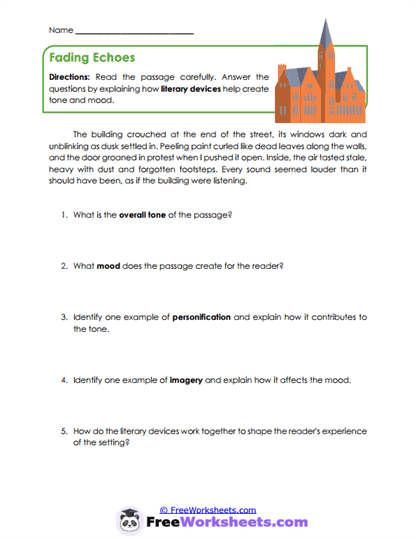
This worksheet focuses on tone and mood, which are both about how a piece of writing makes the reader feel. Tone is the author’s attitude, while mood is the feeling created for the reader, and students often need practice telling the difference. Your child will read a descriptive passage and look closely at how words create a certain atmosphere. This is an important Grade 9 skill because students are expected to explain not just what a text says, but how it feels and why. For example, describing a building as “heavy with dust and forgotten footsteps” creates a quiet, eerie mood.
Curriculum and Grade Alignment
This worksheet is designed for Grade 9 students learning how to analyze tone and mood using textual evidence. The goal is to help students connect literary devices like imagery and personification to emotional impact. Students should already be familiar with basic literary terms before starting. This aligns with Common Core Standard CCSS.ELA-LITERACY.RL.9-10.4, which focuses on word choice and its effect on meaning and tone. It also supports TEKS 9.6, where students analyze how authors create atmosphere and feeling in a text.
Student Tasks
On this worksheet, students will read a descriptive passage about an old building and answer questions about tone and mood. They will identify the overall tone and describe the mood created for the reader. Students must also find examples of literary devices like imagery and personification and explain how they contribute to the feeling. They will write complete responses that connect details from the text to their ideas. This encourages careful reading and thoughtful explanation.
Common Challenges and Misconceptions
Students often confuse tone and mood, thinking they are the same thing when they are slightly different. Some may give very general answers like “it feels sad” without explaining why. Others may struggle to find strong examples from the text to support their ideas. It can also be challenging to describe feelings using precise language. A helpful strategy is to have students underline words in the passage that create a strong image or feeling before answering.
Implementation Guidance
Teachers can use this worksheet as part of a lesson on descriptive writing or analyzing mood. It works well as independent practice or as a guided discussion where students share their interpretations. At home, parents can support by asking simple questions like, “How does this place feel to you?” This helps students think more deeply without needing technical knowledge. It’s also a great way to build stronger writing responses.
Details and Features
This worksheet includes a rich, descriptive passage that is appropriate for Grade 9 readers. The questions are designed to move from basic identification to deeper explanation. There is clear space for students to write their answers in full sentences. The layout is simple and easy to follow. It prints cleanly and works well in both classroom and home settings.