
About This Worksheet
This worksheet is about story sequence, which means understanding the order that events happen in a story. Your child will break a story into clear steps from beginning to end. This helps them see how one event leads to the next. For example, the beginning sets up the story, and later events build toward a big moment. This skill is important because it helps students stay organized when reading.
Curriculum and Grade Alignment
This worksheet is designed for 9th grade students learning how to track events in a text. The goal is to help students understand how stories are structured over time. Before this, students should understand basic story elements like characters and setting. Next, they will analyze plot and theme more deeply. This aligns with CCSS.ELA-LITERACY.RL.9-10.3 and TEKS 9.6.
Student Tasks
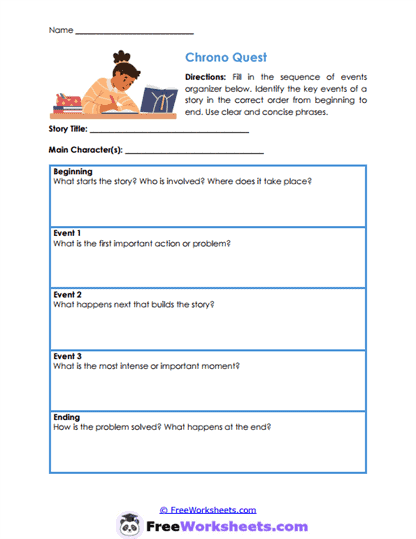
On this worksheet, students will write the title and identify the main characters. They will describe the beginning of the story, including where it takes place. Students then list key events in order, building up to the most important moment. Finally, they explain how the story ends. This helps them organize what they read in a clear way.
Common Challenges and Misconceptions
Students may mix up the order of events if they read too quickly. Some might include details that are not important. Others may skip steps in the sequence. A common mistake is focusing too much on one part of the story. Teachers can help by encouraging students to go back and check the order carefully.
Implementation Guidance
Teachers can use this worksheet during lessons on plot and story structure. It works well after reading a short story or chapter. At home, you can ask your child to retell a story in order. This builds strong comprehension skills. Over time, your child will better understand how stories are built.
Details and Features
The worksheet includes clear sections for each part of the story. It guides students step by step through the sequence. The layout is simple and easy to follow. It is printable and ready to use. The design supports organized thinking.