
About This Worksheet
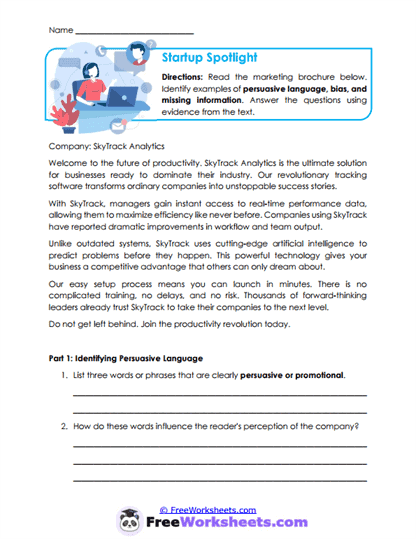
This worksheet is about analyzing persuasive language and bias, which means understanding how writers try to convince readers using strong or emotional wording. It focuses on a marketing brochure for a company. Students learn how businesses highlight positives and sometimes leave out important details. For example, “ultimate solution” becomes persuasive language meant to impress readers. This helps students become more critical readers of advertisements.
Curriculum and Grade Alignment
This worksheet is designed for Grade 9 students studying persuasive and informational texts. The main goal is to help students identify bias, persuasive language, and missing information. Students should already understand basic reading comprehension and tone. Next, they will evaluate the strength and fairness of arguments. This aligns with CCSS.ELA-LITERACY.RI.9-10.8 and RI.9-10.6, along with TEKS 9.6.
Student Tasks
On this worksheet, students will read a marketing brochure about a company. They will identify words or phrases that are clearly persuasive. Students must explain how those words influence the reader. They also think about what information might be missing from the text. This helps them analyze writing more deeply.
Common Challenges and Misconceptions
Students may think all information in a brochure is completely factual. Some might struggle to recognize bias in positive language. Others may find it hard to explain why certain words are persuasive. A common mistake is not considering what is left out of the text. Teachers can help by modeling how to question what is not being said.
Implementation Guidance
Teachers can use this worksheet during lessons on advertising or persuasive writing. It works well for group discussions about marketing strategies. Parents can use it at home by talking about ads they see together. This activity helps students become smarter consumers of information. It also builds strong critical thinking skills.
Details and Features
The worksheet includes a realistic and engaging marketing example. It focuses on both reading and analysis skills. The format allows for written explanations. It is printable and classroom-ready. The design encourages thoughtful evaluation of text.