
About This Worksheet
This worksheet is about connotation, which means the feeling or emotion a word suggests beyond its basic meaning. Students learn how word choices can change the tone of a passage. It focuses on reading a short text and noticing how different words create different impressions. For example, “remade” becomes “taken over,” showing a more negative feeling. This helps students understand that words are powerful and can shape opinions.
Curriculum and Grade Alignment
This worksheet is aimed at Grade 9 students learning to analyze word choice and tone. The goal is to help students recognize how authors influence readers through language. Students should already understand basic vocabulary meanings before starting this. Next, they will move into analyzing how tone supports an author’s purpose. This aligns with CCSS.ELA-LITERACY.RI.9-10.4, which focuses on word meaning and tone, and TEKS 9.5 for vocabulary and language analysis.
Student Tasks
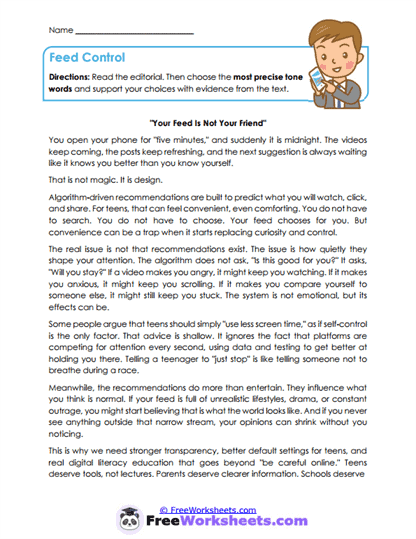
On this worksheet, students will read a passage about changes in a neighborhood and think about how those changes are described. They will compare pairs of words and decide which one has a more negative feeling. Students must circle the stronger negative connotation in each pair. They also reflect on how different word choices change the meaning of the passage. This builds awareness of how language can influence thinking.
Common Challenges and Misconceptions
Students often think words with similar meanings feel the same, which is not true. They may struggle to explain why one word feels more negative than another. Some might guess instead of really thinking about the emotional impact. Others may not connect word choice to the bigger idea of tone. Teachers should encourage students to ask, “How does this word make me feel?” to guide their thinking.
Implementation Guidance
Teachers can use this worksheet during lessons on tone, word choice, or persuasive writing. It works well as a warm-up or small group activity where students discuss their choices. Parents can support learning by talking about word meanings in everyday conversations. This activity also fits nicely into discussions about media and how language shapes opinions. It helps students become more thoughtful readers and writers.
Details and Features
The worksheet includes a short, realistic passage that feels relevant to students. It provides clear word pair choices that focus on subtle differences in meaning. The format is simple and easy to follow, making it accessible for all learners. It is printable and works well for both classroom and homework use. The activity encourages critical thinking without overwhelming students.