
About This Worksheet
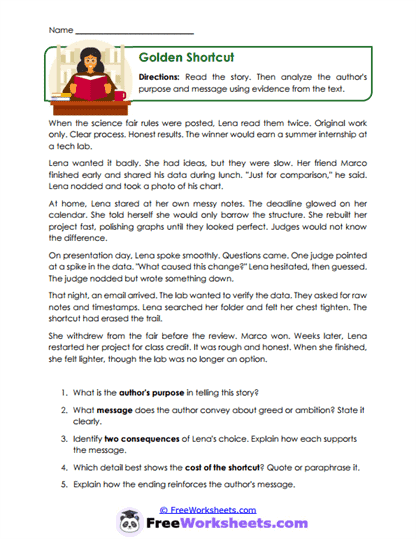
This worksheet helps students think about author’s purpose and the message behind a story, which is a big step in Grade 9 reading. Instead of just asking “what happened,” students are asked to think, “why did the author write this?” The story focuses on a student who takes a shortcut and faces the consequences, which opens the door to a bigger lesson about honesty and responsibility. For example, Lena changing her data shows how a small decision can lead to bigger problems. This helps students see that stories often teach life lessons, not just tell events.
Curriculum and Grade Alignment
This worksheet aligns with CCSS.ELA-LITERACY.RL.9-10.2, which asks students to determine a theme and explain how it develops. Students should already be comfortable identifying basic themes before working on this. The next step is comparing themes across different texts and understanding how authors shape meaning. It also supports TEKS §110.36(b)(5), which focuses on analyzing theme and author’s message. These are important skills as students move into more advanced reading.
Student Tasks
On this worksheet, students will read the story and figure out what message the author is trying to send. They’ll explain how the character’s choices connect to that message. Students are also asked to identify consequences and explain why they matter. Some questions push them to think about how the ending ties everything together. This encourages students to look beyond the surface and really understand the story.
Common Challenges and Misconceptions
Many students confuse author’s purpose with simply retelling the story. Others may recognize the problem but not connect it to a larger message. Some students also struggle to explain how consequences support the theme. These are common at this level as thinking becomes more abstract. A helpful approach is to ask students, “What lesson could someone learn from this?”
Implementation Guidance
Teachers can use this worksheet during a unit on theme, ethics, or decision-making. It works well as a discussion piece where students share different interpretations. At home, parents can talk through the story by asking simple questions like, “Was that a good choice?” or “What happened because of it?” Keeping the focus on real-life connections makes it easier to understand. This kind of conversation builds deeper thinking skills.
Details and Features
The worksheet includes a short, engaging story and five thoughtful questions. The layout is clean and easy for students to follow. Questions are designed to move from basic understanding to deeper analysis. It prints clearly and works well for both classroom and home use. The structure supports written responses and meaningful discussion.