
About This Worksheet
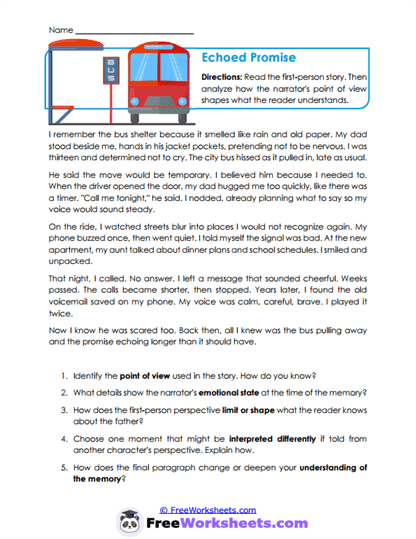
This worksheet focuses on point of view, which means who is telling the story and how that shapes what we understand. In Grade 9, students learn that the same story can feel very different depending on who tells it. This story is told in first person, so we only see events through one character’s thoughts and feelings. For example, the narrator remembering the past shows how emotions can change how a story is told. This helps students see that perspective matters a lot in reading.
Curriculum and Grade Alignment
This worksheet aligns with CCSS.ELA-LITERACY.RL.9-10.6, which focuses on analyzing point of view. Students should already know the difference between first-person and third-person narration. The next step is understanding bias and how perspective shapes meaning. It also connects to TEKS §110.36(b)(7), which includes analyzing how viewpoint affects a story. These skills are key for deeper literary analysis.
Student Tasks
On this worksheet, students will identify the point of view used in the story. They will explain how the narrator’s feelings affect what is shared. Students are also asked to think about how the story might change if someone else told it. Some questions guide them to look closely at emotional details. This helps them understand how perspective shapes meaning.
Common Challenges and Misconceptions
Students sometimes think the narrator is the same as the author, which can lead to confusion. Others may miss how emotions influence the story. Some students also struggle to imagine a different perspective. These are common challenges as students begin deeper analysis. Teachers can help by asking, “What do we know because of who is telling this?”
Implementation Guidance
Teachers might use this worksheet during a unit on narration or perspective. It works well as both independent work and group discussion. At home, parents can ask their child how the story would feel if another character told it. This keeps the idea simple but meaningful. It’s a great way to build critical reading skills.
Details and Features
The worksheet includes a first-person narrative that is easy to follow but rich in meaning. The questions are clearly written and guide students step by step. There is space for thoughtful written responses. It prints cleanly and is ready to use. The format supports both reflection and analysis.