
About This Worksheet
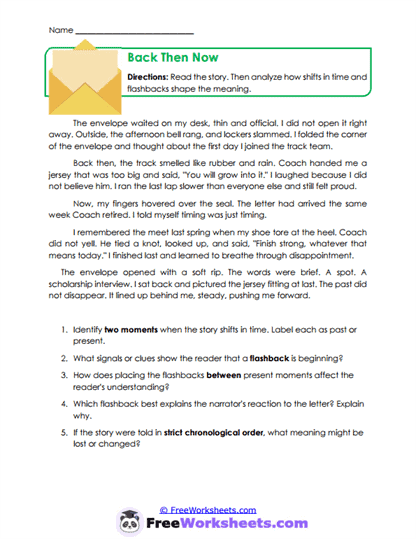
This worksheet focuses on understanding shifts in time, especially flashbacks, and how they affect a story. In Grade 9, students learn that stories are not always told in a straight line. Authors often move between past and present to add meaning. For example, remembering a past failure can explain why a character feels nervous in the present. This helps students see how time changes can deepen understanding.
Curriculum and Grade Alignment
This worksheet aligns with CCSS.ELA-LITERACY.RL.9-10.5, which focuses on analyzing how a text is structured. Students should already understand basic plot order before trying this. The next step is analyzing more complex structures, like multiple timelines. It also connects to TEKS §110.36(b)(6), which includes understanding narrative techniques. These skills are important for reading more advanced texts.
Student Tasks
On this worksheet, students will identify moments when the story shifts between past and present. They will label each part and explain what is happening. Students are also asked to look for clues that signal a flashback. Some questions guide them to explain how these shifts affect the meaning of the story. This helps them understand why authors use this technique.
Common Challenges and Misconceptions
Students often miss subtle clues that show a shift in time. Some may confuse the order of events. Others might not understand why the author included a flashback at all. These are common challenges when working with more complex texts. Teachers can help by pointing out signal words and discussing purpose.
Implementation Guidance
Teachers can use this worksheet during lessons on story structure or narrative techniques. It works well as guided practice before independent reading. At home, parents can ask their child to explain what happened first and what happened later. Keeping it simple helps build understanding. This activity supports stronger comprehension skills over time.
Details and Features
The worksheet includes a short story with clear but meaningful time shifts. The questions are organized to help students move step by step through the analysis. There is space for written responses. It is easy to print and use in different learning settings. The design supports both clarity and deeper thinking.