
Compare Exact And Approximate
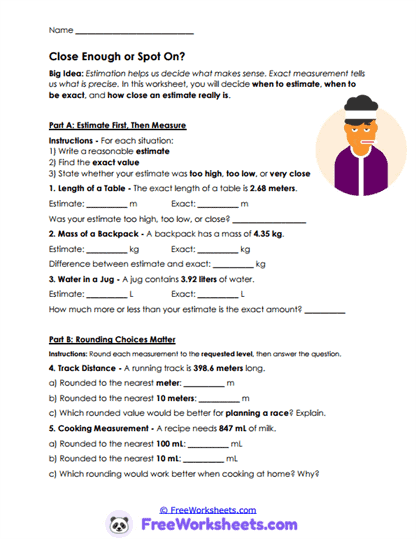
This worksheet teaches students how to decide when estimation is appropriate and how close estimates are to exact measurements. Learners compare estimated values with exact values while strengthening understanding of rounding and measurement accuracy. The activity builds number sense through practical examples involving tables, backpacks, tracks, and recipes. For example, students may round 847 milliliters to the nearest 100 milliliters or nearest 10 milliliters and compare the results. The worksheet also encourages learners to explain why certain estimates are more useful in different situations.
Standards Connection
This worksheet supports Grade 8 concepts involving estimation, measurement accuracy, and numerical reasoning. Students strengthen practical math skills needed for science, engineering, and everyday decision making. Learners should already understand rounding and metric measurement before beginning this activity. The worksheet aligns with Common Core standards involving estimation and quantitative reasoning. It also supports TEKS 8.1A and 8.4A through using approximation and evaluating measurement reasonableness.
Estimate And Reflect
On this worksheet, students will estimate measurements, compare estimates with exact values, and analyze how accurate the estimates are. Learners round measurements to different place values depending on the context of the problem. Some questions ask students to decide whether an estimate is too high, too low, or very close to the actual amount. Students also explain which type of rounding is more useful in practical situations. The activity strengthens both numerical reasoning and measurement judgment.
Frequent Errors
Many students round to the wrong place value because they overlook the directions carefully. Some learners assume all estimates should be as precise as possible instead of choosing practical levels of accuracy. Others struggle to explain why one estimate may work better than another depending on the situation. Students may also forget that estimation is meant to produce reasonable values rather than exact answers. Teachers can support understanding by discussing when precision matters most in everyday life.
Teaching Ideas
Teachers can use this worksheet during estimation lessons, number-sense warm-ups, or measurement review activities. Parents and homeschool educators may support students by discussing real-world examples involving cooking, sports, shopping, or construction estimates. The activity also works well for classroom discussions where learners compare different estimation strategies and justify their reasoning. Students benefit from seeing that estimation is useful for quick decisions and planning. Real-life contexts help learners connect mathematical reasoning to practical situations.
Worksheet Features
The worksheet combines estimation, exact measurement comparison, and rounding analysis for deeper mathematical thinking. Organized writing spaces allow students to explain reasoning clearly and neatly. Problems involve both measurement and practical judgment situations for balanced review. Student-friendly directions support classroom instruction and independent completion. The printable format works well for middle school classrooms, tutoring programs, and homeschool mathematics lessons.