
Compare Volume And Capacity
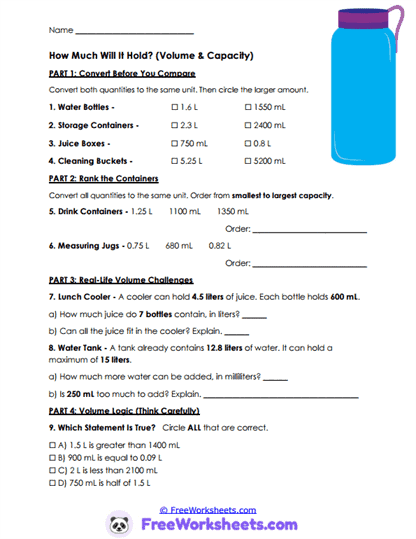
This worksheet teaches students how to compare, convert, and reason about volume and capacity measurements. Learners work with liters and milliliters while solving practical problems involving containers, coolers, tanks, and storage amounts. The activity strengthens measurement fluency by helping students determine which capacities are larger and whether amounts fit within given limits. For example, students may convert milliliters to liters before ranking capacities from smallest to largest. The worksheet also encourages students to explain whether container capacities are reasonable.
Standards Connection
This worksheet supports Grade 8 concepts involving volume, capacity, metric conversions, and quantitative reasoning. Students strengthen practical math skills needed for science, engineering, and real-world measurement applications. Learners should already understand liters, milliliters, and basic metric conversions before beginning this activity. The worksheet aligns with Common Core standards involving measurement conversion and quantitative comparison. It also supports TEKS 8.4A and 8.5C through solving contextual problems involving capacity and volume relationships.
Work With Capacity
On this worksheet, students will compare capacities written in liters and milliliters after converting them into matching units. Learners rank containers from smallest to largest and solve real-world problems involving coolers and water tanks. Some questions ask students to determine whether a certain amount can fit within a container’s maximum capacity. Students also evaluate statements about volume and identify which claims are true. The activity strengthens measurement reasoning and practical conversion skills.
Common Challenges
Many students forget to convert all measurements into the same unit before comparing capacities. Some learners confuse liters and milliliters because the numerical values can appear misleading. Others make mistakes calculating remaining space inside containers. Students may also struggle to interpret whether statements about capacity are reasonable. Teachers can support understanding by modeling conversion relationships visually and discussing real container sizes students recognize from everyday life.
Teaching Ideas
Teachers can use this worksheet during measurement review lessons, science connections, or collaborative problem-solving activities. Parents and homeschool educators may support students by discussing beverage containers, storage tanks, and kitchen measurements at home. The activity also works well for partner discussions where learners explain why one container holds more than another. Students benefit from connecting conversions to realistic situations because it strengthens practical understanding of measurement. Real-world capacity problems help learners see how math applies to daily decision making.
Worksheet Features
The worksheet includes comparison tasks, ranking activities, and real-world volume challenges for balanced measurement practice. Organized response spaces support neat calculations and careful unit labeling. Problems gradually vary in difficulty to strengthen flexibility and confidence. Student-friendly directions support classroom instruction and independent completion. The printable format works well for middle school classrooms, tutoring sessions, and homeschool mathematics lessons.