
About This Worksheet
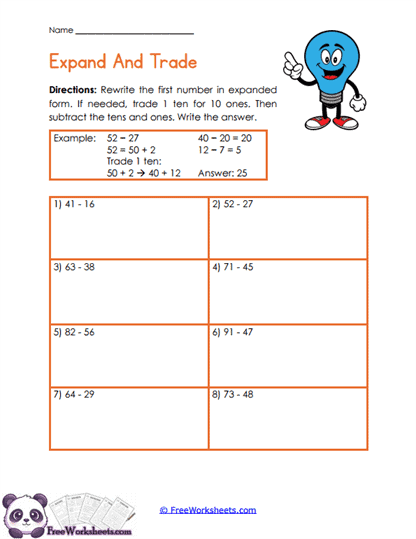
Expanded Exchange is a second grade subtraction activity that helps students regroup using expanded form. Each problem begins with a two-digit subtraction equation and asks students to rewrite the first number as tens and ones. When the ones are too small to subtract, students trade one ten and rewrite the number with more ones before solving. For example, 52 − 27 can be changed from 50 + 2 into 40 + 12 so that 12 − 7 can be completed. This helps children connect regrouping directly to decomposition and place value.
Curriculum and Grade Alignment
This worksheet is made for second grade learners who are ready to use expanded notation to explain regrouping. The main goal is to help students see how a number can be renamed without changing its value. Before using this page, your child should understand expanded form and know how tens and ones combine to make a two-digit number. The next step is using the same place-value thinking more efficiently in vertical subtraction. This activity supports decomposition, equivalence, and subtraction with regrouping.
Student Tasks
Students will solve eight subtraction problems using expanded-form work. They decompose the first number, trade one ten for 10 ones when needed, subtract the tens and ones, and then combine the results. A worked example at the top models the full process with 52 − 27. The practice problems include 41 − 16, 52 − 27, 63 − 38, 71 − 45, 82 − 56, 91 − 47, 64 − 29, and 73 − 48. This builds deep understanding of the regrouping process.
Common Challenges and Misconceptions
Some students may rewrite 52 as 40 + 2 instead of 40 + 12 after trading. Others may correctly regroup but then subtract the tens or ones incorrectly. A child may also forget that the renamed form must still equal the original number. Encourage your child to check that 40 + 12 still equals 52 before subtracting. This reinforces the idea that regrouping changes the form, not the value.
Implementation Guidance
Teachers can use this worksheet after place-value charts and before expecting full independence with the standard algorithm. It works especially well for students who need to see where the extra ones come from. Parents can ask the child to explain why 50 + 2 and 40 + 12 are equal. If needed, represent both forms with base-ten blocks. This helps connect expanded form to the concrete exchange.
Details and Features
This worksheet includes one worked example and eight large practice boxes. Each problem provides space for students to rewrite, trade, subtract, and record the answer. The orange-bordered layout gives plenty of room for showing work. The printable supports expanded form, decomposition, regrouping, and place-value understanding.