
About This Worksheet
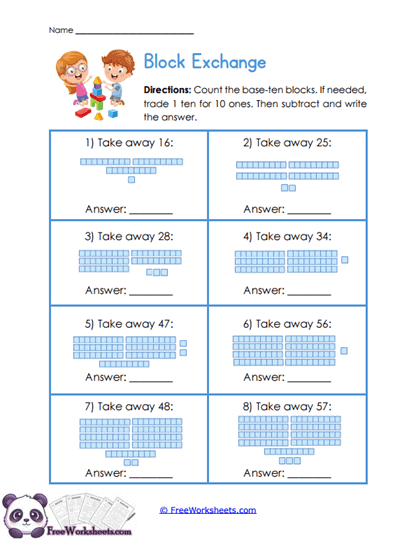
Base-Ten Exchange is a second grade visual subtraction activity that helps students understand regrouping with place-value blocks. Each problem shows a starting quantity made from tens rods and ones cubes, then tells students how much to take away. When there are not enough ones to subtract, children trade 1 ten for 10 ones before finding the difference. For example, a problem may require taking away 16 from a number that does not have enough ones available at first. This makes the regrouping process visible and concrete.
Curriculum and Grade Alignment
This worksheet is made for second grade learners who are beginning subtraction with regrouping. The main goal is to help students see why a ten must sometimes be exchanged for 10 ones. Before using this page, your child should understand that a tens rod represents 10 and a ones cube represents 1. The next step is recording the same trade in a place-value chart or standard vertical subtraction problem. This activity supports base-ten understanding, place value, and subtraction with regrouping.
Student Tasks
Students will complete eight base-ten subtraction problems. They count the starting blocks, determine how many need to be removed, trade 1 ten for 10 ones when necessary, and then subtract. Each problem provides a clear answer line for the final difference. The take-away amounts include values such as 16, 25, 28, 34, 47, 56, 48, and 57. This builds visual reasoning and understanding of the exchange process.
Common Challenges and Misconceptions
Some students may remove the ones first without noticing that there are not enough. Others may trade a ten for 10 ones but forget that the total value has not changed. A child may also count the regrouped blocks incorrectly after the exchange. Encourage your child to say, “1 ten becomes 10 ones,” before continuing. This reinforces the meaning of the trade.
Implementation Guidance
Teachers can use this worksheet immediately after hands-on work with real base-ten blocks. It works well in small groups because students can explain when and why they need to make a trade. Parents can recreate one problem with bundled straws or groups of 10 small objects. Have the child physically exchange one group of ten for ten individual pieces before subtracting. This keeps the written worksheet connected to concrete place value.
Details and Features
This worksheet includes eight visual subtraction problems in a blue two-column grid. Each problem uses tens rods and ones cubes and gives a specific amount to take away. The models are designed to encourage regrouping when necessary. The printable supports base-ten models, place-value exchanges, subtraction concepts, and regrouping.