
About This Worksheet
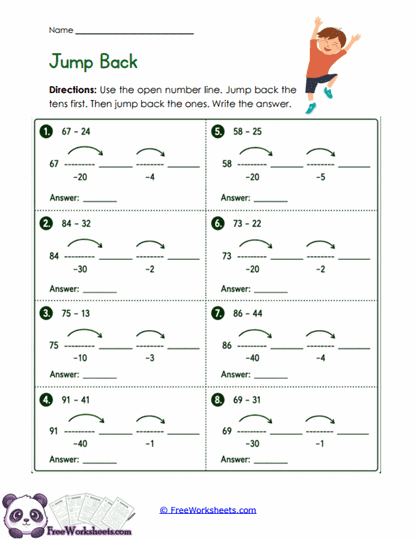
Backward Jumps is a second grade subtraction activity that helps students use an open number line to subtract tens and ones in separate steps. Each problem starts with the larger number and shows one jump back for the tens and another jump back for the ones. Students write the number they land on after each jump and then record the final difference. For example, 67 − 24 becomes a jump back 20 and then a jump back 4. This helps children connect subtraction with movement backward on a number line.
Curriculum and Grade Alignment
This worksheet is made for second grade learners who are ready to use number-line strategies for two-digit subtraction. The main goal is to help students decompose the number being subtracted into tens and ones and subtract each part in order. Before using this page, your child should be comfortable subtracting multiples of 10 and small one-digit amounts. The next step is making similar backward jumps mentally without drawn arrows. This activity supports number-line reasoning, decomposition, place value, and mental subtraction.
Student Tasks
Students will solve eight two-digit subtraction problems. They begin with the first number, subtract the tens part, write the intermediate result, then subtract the ones part. Problems include 67 − 24, 84 − 32, 75 − 13, 91 − 41, 58 − 25, 73 − 22, 86 − 44, and 69 − 31. The arrows and labels guide students through each step. This builds mental math, subtraction fluency, and visual understanding of distance between numbers.
Common Challenges and Misconceptions
Some students may jump forward instead of backward because they are more familiar with addition number lines. Others may subtract the tens correctly but lose track of the landing number before subtracting the ones. A child may also treat −20 as −2. Encourage your child to say each move aloud, such as, “67 back 20 is 47; back 4 is 43.” This keeps the direction and amount of each jump clear.
Implementation Guidance
Teachers can use this worksheet after students have practiced breaking apart a subtrahend into tens and ones. It works well as a visual bridge between decomposition and mental subtraction. Parents can draw a longer number line if the printed jumps feel too abstract. Ask the child to point left while subtracting so the direction remains connected to decreasing value. As confidence grows, encourage them to picture the jumps mentally.
Details and Features
This worksheet includes eight open-number-line subtraction problems arranged in a two-column grid. Each problem shows the starting number, labeled backward jumps, spaces for intermediate values, and a final answer line. The green-bordered design keeps the visual steps easy to follow. The printable supports open number lines, mental subtraction, decomposition, and place-value reasoning.