
About This Worksheet
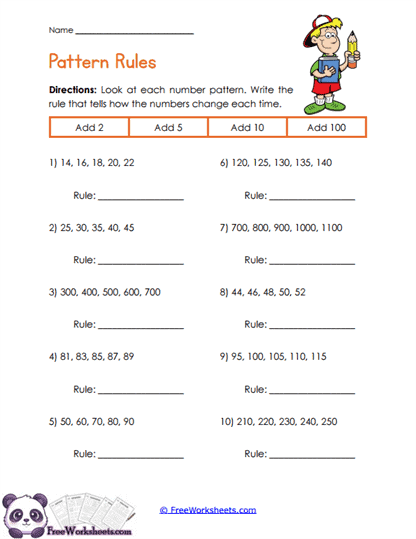
Rule Reader is a second grade pattern-analysis activity that asks students to name the rule used in each number sequence. Every problem gives a completed pattern and students decide whether the numbers increase by 2, 5, 10, or 100. A rule bank at the top lists the four choices. For example, 14, 16, 18, 20, 22 follows the Add 2 rule, while 300, 400, 500, 600, 700 follows Add 100. This helps children put mathematical language to patterns they may already recognize by sight.
Curriculum and Grade Alignment
This worksheet is made for second grade learners who are strengthening their ability to describe number patterns. The main goal is to help students identify repeated numerical changes and name the correct rule. Before using this page, your child should be able to extend skip-counting patterns by 2s, 5s, 10s, and 100s. The next step is creating their own patterns from a given rule. This activity supports mathematical vocabulary, sequence analysis, and repeated-addition reasoning.
Student Tasks
Students will examine ten completed number sequences. They compare consecutive numbers, determine the repeated increase, and write the matching rule on the line. The answer choices are Add 2, Add 5, Add 10, and Add 100. The starting values vary, so students need to focus on the difference rather than on memorized number lists. This builds rule recognition, mental subtraction, and mathematical communication.
Common Challenges and Misconceptions
Some students may choose a rule based on the size of the numbers rather than the amount they change. Others may confuse Add 10 with Add 100 when working with three-digit numbers. A child may also look only at the first and last numbers instead of checking each step. Encourage your child to compare two neighboring values and ask, “How much did the number grow?” Then verify the same change again.
Implementation Guidance
Teachers can use this worksheet after students have practiced both extending and completing skip-counting sequences. It works well as a quick assessment of whether children understand the rule behind a pattern. Parents can have the child write +2, +5, +10, or +100 above the spaces between numbers before naming the rule. This makes the repeated change easier to see. If needed, use a number line to show the size of each jump.
Details and Features
This worksheet includes ten completed patterns and a four-choice rule bank. Students write one rule for each sequence. Patterns include counting by 2s, 5s, 10s, and 100s using a variety of starting numbers. The two-column layout keeps the page organized and easy to scan. The printable supports pattern vocabulary, repeated addition, rule identification, and number sense.