
About This Worksheet
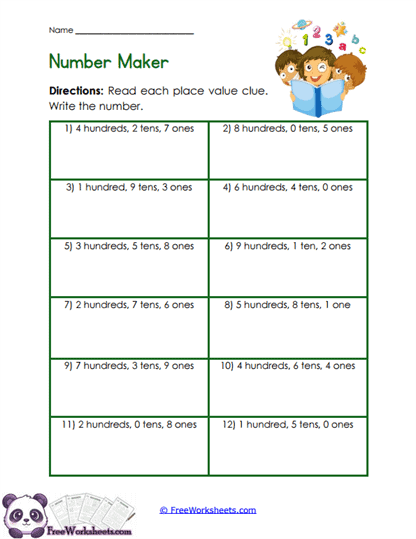
Number Builder is a second grade place-value activity that asks students to turn hundreds, tens, and ones clues into standard-form numbers. Each problem describes a number using place-value language, such as 4 hundreds, 2 tens, and 7 ones. Students combine those parts to write the complete three-digit number. For example, 4 hundreds, 2 tens, and 7 ones makes 427. This helps children understand how each place contributes to the value of the whole number.
Curriculum and Grade Alignment
This worksheet is made for second grade learners who are practicing how to compose three-digit numbers from place-value parts. The main goal is to help students connect hundreds, tens, and ones with standard notation. Before using this page, your child should understand what each place represents. The next step is moving between standard form, expanded form, and place-value clues without extra support. This activity strengthens number composition, place-value reasoning, and fluency within 1,000.
Student Tasks
Students will solve twelve place-value clue problems. Each clue gives the number of hundreds, tens, and ones, and students write the numeral that matches. Some problems include a zero in one place, such as 2 hundreds, 0 tens, and 8 ones. Others use all three places. This builds careful reading, number composition, and understanding of zero as a placeholder.
Common Challenges and Misconceptions
Some students may write the values in the wrong order or forget to include a zero when a place has none. Others may add the parts correctly but write the numeral with the digits reversed. A child may also confuse the number of tens with the total value of the tens. Encourage your child to say the number as “hundreds, tens, ones” before writing it. This keeps the place order clear.
Implementation Guidance
Teachers can use this worksheet after students have practiced place-value charts and base-ten blocks. It works well as independent practice because each problem follows the same clue-to-number routine. Parents can ask the child to point to an imaginary hundreds, tens, and ones column while reading each clue. If needed, draw a quick H-T-O chart beside a difficult problem. This provides support without changing the core task.
Details and Features
This worksheet includes twelve place-value clue boxes in a green grid. Each problem asks students to write one three-digit number from the given hundreds, tens, and ones. Several items include zero in one place for added practice. Large open boxes provide room for written answers. The printable supports standard form, place value, number composition, and zero-place understanding.