
About This Worksheet
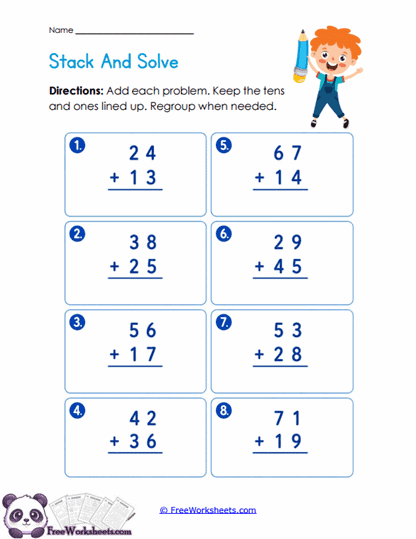
Column Sums is a second grade addition activity that helps students practice adding two-digit numbers in vertical form. Each problem places one addend above the other so the tens and ones columns are lined up. Students add the ones first, regroup when needed, and then add the tens. For example, in 38 + 25, the 8 and 5 are added in the ones column before working with the tens. This helps children build the standard addition process in a clear and organized way.
Curriculum and Grade Alignment
This worksheet is intended for second grade learners who are ready to practice stacked two-digit addition. The main goal is to help students line up place values correctly and solve problems with and without regrouping. Before beginning, your child should understand that the right-hand column is the ones place and the left-hand column is the tens place. The next step is solving more vertical addition problems independently and checking answers with another strategy. This activity supports standard addition, place value, and regrouping.
Student Tasks
On this worksheet, students will solve eight vertically arranged addition problems. They add the ones, regroup if the ones total 10 or more, and then add the tens. The problems include examples such as 24 + 13, 38 + 25, 56 + 17, and 71 + 19. Students write the sum beneath each problem. This builds column alignment, calculation accuracy, and confidence with regrouping.
Common Challenges and Misconceptions
Some students may start with the tens instead of the ones and then forget to handle regrouping correctly. Others may write the regrouped ten in the wrong place. A child may also line up digits incorrectly if copying a problem. Encourage your child to check that ones are under ones and tens are under tens before adding. Using a small place-value label above the columns can help while the strategy is still new.
Implementation Guidance
Teachers can use this worksheet after modeling vertical addition with place-value charts or base-ten blocks. It works well for independent practice once students understand what regrouping means. Parents can ask the child to point to the ones column first and explain whether regrouping will be needed. If a problem is difficult, solve it again with tens rods and ones cubes. This helps connect the written method to the place-value idea behind it.
Details and Features
This worksheet includes eight stacked two-digit addition problems in large bordered boxes. The numbers are already lined up by place value, so students can focus on the addition process. Several problems require regrouping, while others provide simpler practice. Large writing spaces make it easy to show regrouped tens and final sums. The printable supports vertical addition, place-value alignment, regrouping, and computation fluency.