
About This Worksheet
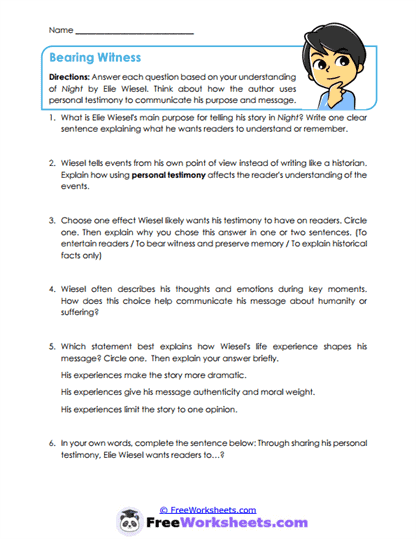
Bearing Witness is a grade 9 nonfiction analysis worksheet focused on understanding how personal testimony shapes purpose and message in Night by Elie Wiesel. It is a high school literacy resource that strengthens students’ ability to analyze how first-person narration influences reader response. The questions guide students to consider how Wiesel’s personal perspective adds emotional weight and authenticity. For example, describing events through lived experience becomes more powerful than a detached historical account. This worksheet develops students’ ability to evaluate how narrative voice affects credibility and meaning.
Curriculum and Grade Alignment
This worksheet is designed for Grade 9 and emphasizes analyzing point of view and author purpose in literary nonfiction. The primary learning goal is to explain how first-person narration influences understanding of historical events. Students should already understand narrative perspective before completing this activity. The next progression skill involves evaluating how author choices shape tone and impact. This resource aligns with CCSS.ELA-LITERACY.RI.9-10.6 and RL.9-10.6, which address author perspective and point of view.
Student Tasks
On this worksheet, students will answer questions about Elie Wiesel’s purpose in sharing his story. They analyze how personal testimony shapes readers’ emotional and intellectual responses. Learners evaluate how specific narrative choices strengthen authenticity and moral weight. Students complete short written explanations supported by textual understanding. Each response encourages thoughtful reflection on memoir and historical memory.
Common Challenges and Misconceptions
Students may summarize events instead of analyzing narrative purpose. Some learners might struggle to distinguish between emotional impact and historical fact. Others may find it difficult to explain how personal voice increases credibility. Identifying implicit messages can also be challenging. Teachers can model discussing how first-person perspective changes interpretation.
Implementation Guidance
Teachers can use this worksheet during a unit on Holocaust literature or memoir study. It works well as guided discussion before writing analytical paragraphs. In small groups, students can compare how testimony differs from textbook history. Homeschool educators may guide reflective conversations about perspective and memory. This worksheet supports ethical reflection and literary analysis.
Details and Features
The worksheet includes focused analytical questions tied to Night. Prompts require concise written responses with thoughtful explanation. The layout is structured for individual or small-group use. The printable format is classroom-ready and easy to distribute. The questions promote deeper engagement with historical nonfiction.