
Choose The Best Units
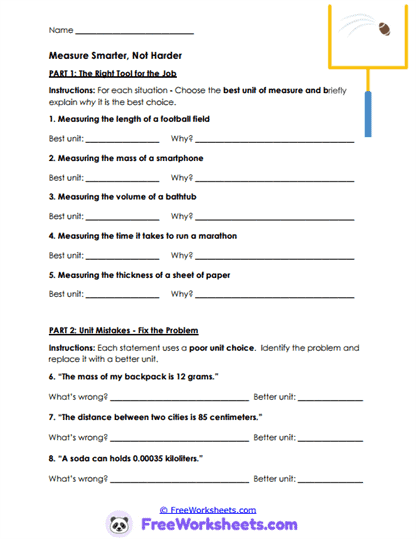
This worksheet teaches students how to select appropriate units of measurement for different real-world situations. Learners analyze measurement contexts involving length, mass, volume, and time while deciding which units make the most sense. The activity strengthens practical reasoning by helping students understand why certain units fit better than others. For example, students may decide whether grams or kilograms are more appropriate for measuring the mass of a smartphone. The worksheet also encourages students to identify and correct unrealistic measurement choices.
Standards Connection
This worksheet supports Grade 8 concepts involving measurement reasoning, unit selection, and practical problem solving. Students strengthen mathematical thinking skills needed for science, engineering, and everyday decision making. Learners should already understand metric units and basic measurement relationships before beginning this activity. The worksheet aligns with Common Core standards involving quantitative reasoning and measurement applications. It also supports TEKS 8.4A by applying measurement concepts appropriately in real-world contexts.
Match Units To Situations
On this worksheet, students will choose the most appropriate unit of measure for real-life objects and activities. Learners explain why certain units are better suited for measuring specific quantities. Some problems involve selecting reasonable units for length, mass, or volume, while others require identifying incorrect measurement statements and correcting them. Students also practice recognizing unrealistic units in practical situations. The activity strengthens critical thinking and measurement fluency.
Common Mistakes
Many students choose units based only on familiarity instead of considering the size of the object being measured. Some learners confuse large and small metric units when estimating reasonable measurements. Others struggle to explain why one unit works better than another in context. Students may also overlook whether measurements are practical in everyday life. Teachers can support understanding by discussing real-world examples and comparing objects students encounter regularly.
Classroom Applications
Teachers can use this worksheet during measurement lessons, review practice, or classroom discussions about practical math reasoning. Parents and homeschool educators may support students by talking about measurements used in cooking, sports, shopping, or travel. The activity also works well for collaborative learning where students debate which unit best fits a situation. Learners benefit from seeing how unit choices affect accuracy and communication in real life. Real-world measurement reasoning helps students build confidence using math outside the classroom.
Worksheet Features
The worksheet combines unit-selection tasks with error-analysis problems for deeper measurement understanding. Organized response spaces allow students to explain reasoning clearly and neatly. Problems involve realistic examples that strengthen engagement and practical thinking. Student-friendly directions support classroom instruction and independent completion. The printable design works well for middle school classrooms, tutoring sessions, and homeschool mathematics lessons.