
Learn Square Roots
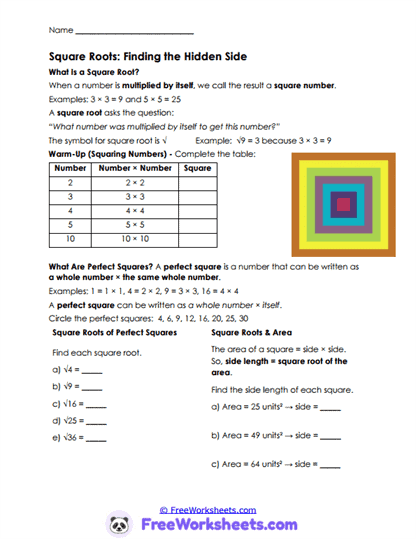
This worksheet introduces students to square roots, perfect squares, and area relationships. Learners study how multiplying a number by itself creates a square number and how square roots reverse that process. The activity strengthens number sense by helping students recognize perfect squares and evaluate square roots accurately. For example, 3 × 3 = 9, so √9 = 3. Students also connect square roots to finding side lengths from area measurements.
Standards Connection
This worksheet supports Grade 8 concepts involving square roots, exponents, and numerical reasoning. Students strengthen foundational algebra and geometry skills needed for future work with irrational numbers and radicals. Learners should already understand multiplication patterns and basic exponents before beginning this activity. The worksheet aligns with Common Core standard 8.EE.A.2 through evaluating square roots of perfect squares. It also supports TEKS 8.2A by applying roots and exponents to numerical relationships.
Explore Perfect Squares
On this worksheet, students will identify perfect squares and evaluate square roots of whole numbers. Learners complete multiplication tables showing repeated factors that form square numbers. Some problems involve simplifying square roots directly, while others connect roots to area and side-length relationships. Students also practice recognizing perfect-square patterns quickly. The activity strengthens understanding of how square roots undo repeated multiplication.
Common Struggles
Many students confuse square roots with division because both involve finding a missing value. Some learners struggle to memorize perfect squares larger than 25. Others incorrectly simplify roots that are not perfect squares into whole numbers. Students may also misunderstand how square roots connect to finding missing side lengths in geometry. Teachers can support understanding by using visual square models and repeated multiplication examples during instruction.
Teaching Support
Teachers can use this worksheet during root-introduction lessons, geometry connections, or review practice activities. Parents and homeschool educators may support students by practicing multiplication patterns and perfect-square charts together. The activity also works well for collaborative learning where learners explain why certain numbers are perfect squares. Students benefit from connecting roots to area models because it strengthens conceptual understanding. Repeated root practice helps build fluency and confidence with radicals.
Worksheet Features
The worksheet includes multiplication tables, perfect-square identification, root evaluation, and geometry connections for balanced practice. Organized response spaces support neat written work and clear calculations. Problems gradually increase in difficulty to strengthen confidence and retention. Student-friendly directions support classroom instruction and independent completion. The printable design works well for middle school classrooms, tutoring programs, and homeschool mathematics lessons.