
Fix Mistakes
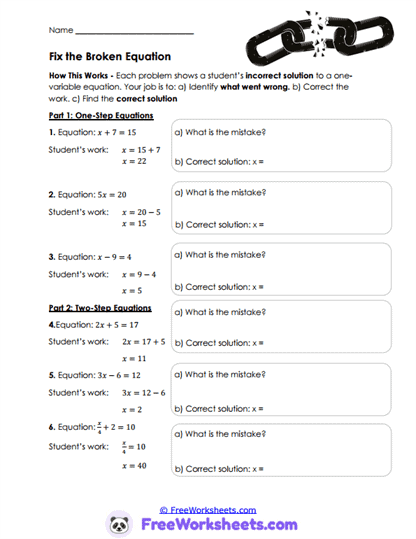
This worksheet teaches students how to analyze and correct mistakes made while solving one-variable equations. Learners examine incorrect student work, identify where the solving process went wrong, and determine the correct solution. The activity strengthens algebra reasoning by encouraging students to think critically about equation-solving steps. For example, students may identify when inverse operations were applied incorrectly or when balance was not maintained. The worksheet also reinforces accurate equation-solving procedures through error analysis.
Standards Connection
This worksheet supports Grade 8 algebra concepts involving solving and analyzing one-variable equations. Students strengthen mathematical reasoning and procedural fluency by studying common solving errors. Learners should already understand inverse operations and basic equation-solving strategies before beginning this activity. The worksheet aligns with Common Core standard 8.EE.C.7 through solving and evaluating linear equations in one variable. It also supports TEKS 8.8A by reinforcing correct equation-solving methods and algebraic reasoning.
Analyze The Errors
On this worksheet, students will review incorrect equation-solving steps and determine what mistake was made in each problem. Learners explain why the solving process failed and then complete the equation correctly. Some problems involve one-step equations while others include multi-step equations requiring more detailed analysis. Students also practice checking whether the corrected answer satisfies the original equation. The activity encourages careful observation and logical algebra thinking.
Student Challenges
Many students can recognize that an answer is wrong but struggle to explain exactly where the mistake happened. Some learners overlook small sign errors or incorrect inverse operations during the solving process. Others may repeat the same error while attempting the correction themselves. Students can also become confused when balancing equations involving multiple operations. Teachers can support understanding by modeling how to trace each algebra step line by line before identifying the mistake.
Classroom Ideas
Teachers can use this worksheet during review lessons, intervention groups, or class discussions about common algebra mistakes. Parents and homeschool educators may support learning by encouraging students to explain why a correction works better than the original solution. The activity also works well for collaborative learning because students can compare different error explanations. Learners benefit from discussing how algebra mistakes happen and how to avoid them in the future. Error-analysis practice helps students become more accurate and reflective problem solvers.
Worksheet Features
The worksheet includes incorrect student work examples that encourage deeper mathematical thinking and analysis. Organized response spaces allow learners to explain mistakes and write corrected solutions clearly. Problems include both one-step and multi-step equations for balanced review practice. Clear directions support independent completion and classroom use. The printable format makes the worksheet useful for middle school instruction, tutoring sessions, and homeschool algebra lessons.