
Build Equations
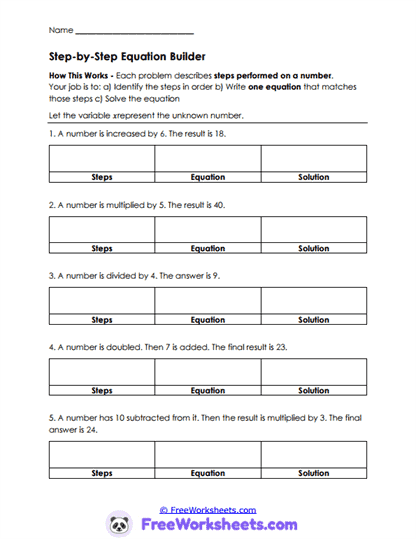
This worksheet teaches students how to build one-variable equations from step-by-step descriptions of operations performed on a number. Learners analyze sequences of mathematical actions and translate them into complete algebraic equations. The activity strengthens algebra reasoning by helping students connect verbal instructions to symbolic math representations. For example, “a number is doubled and then 7 is added” becomes “2x + 7.” Students also solve each equation after building it correctly.
Standards Connection
This worksheet supports Grade 8 algebra skills involving writing and solving one-variable equations. Students strengthen mathematical reasoning and procedural thinking needed for solving multi-step algebra problems. Learners should already understand variables, inverse operations, and operation vocabulary before beginning this activity. The worksheet aligns with Common Core standard 8.EE.C.7 through building and solving linear equations in one variable. It also supports TEKS 8.8A by reinforcing equation creation and algebraic problem-solving methods.
Follow The Steps
On this worksheet, students will read descriptions of operations performed on unknown numbers and convert those descriptions into equations. Learners identify the order of operations carefully before writing each algebraic model. Some problems involve only one operation while others combine multiplication, division, addition, and subtraction into multi-step equations. Students also solve each equation and record the unknown value clearly. The activity encourages organized thinking and accurate algebra setup.
Common Mistakes
Many students write operations in the wrong order when translating verbal descriptions into equations. Some learners confuse phrases like “then added” and “multiplied by” while building expressions. Others solve the equation incorrectly because they skip inverse operation steps. Students may also forget to check whether their solution satisfies the original equation. Teachers can support understanding by encouraging learners to write each operation step separately before combining them into one equation.
Classroom Strategies
Teachers can use this worksheet during lessons on equation writing, guided algebra practice, or review activities. Parents and homeschool educators may support students by reading each description aloud and discussing the sequence of operations together. The activity also works well for collaborative learning where students compare equations and explain how they interpreted the steps. Learners benefit from discussing why operation order matters in algebra. Frequent translation practice helps students strengthen both reading comprehension and equation-solving skills.
Worksheet Features
The worksheet includes organized tables where students record operation steps, equations, and solutions together. Problems gradually increase in complexity to support skill development and confidence. Large writing spaces encourage students to show work clearly and neatly. Student-friendly directions support independent completion and classroom instruction. The printable format makes the worksheet useful for middle school classrooms, tutoring sessions, and homeschool algebra lessons.