
About This Worksheet
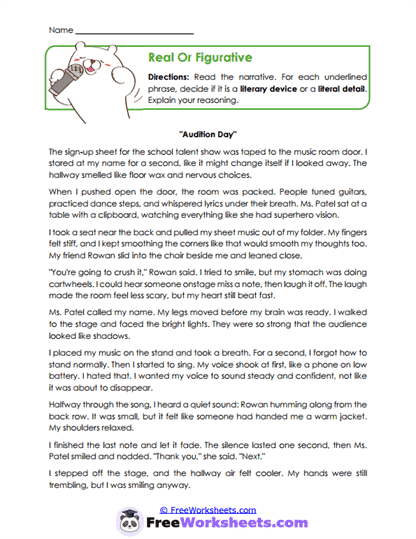
This worksheet is a classification activity focused on distinguishing literal language from figurative language. It is designed for Grade 8 students learning how to recognize literary devices within narrative text. The passage includes underlined phrases that students must evaluate and categorize. For example, “my stomach was doing cartwheels” becomes “I felt very nervous.” This helps students clearly see the difference between literal meaning and figurative expression.
Curriculum and Grade Alignment
This worksheet aligns with Grade 8 standards for understanding and analyzing figurative language. It supports CCSS.ELA-LITERACY.RL.8.4, which focuses on interpreting words and phrases in context. Students should already be familiar with basic literary devices. The next step is accurately identifying and explaining their use in real texts. It also connects to TEKS 8.6(B), which emphasizes analyzing how language affects meaning.
Student Tasks
On this worksheet, students will read a narrative passage with several underlined phrases. They are asked to determine whether each phrase is literal or figurative. Students must explain their reasoning for each decision. They will connect the phrase to its meaning within the context of the story. The task encourages careful thinking and clear explanation.
Common Challenges and Misconceptions
Students may confuse exaggerated literal statements with figurative language. Some might correctly classify phrases but struggle to explain why. Others may rely on guessing rather than analyzing context. It is also common for students to overlook how figurative language adds meaning. Teachers can support learning by modeling examples and guiding students through reasoning steps.
Implementation Guidance
Teachers can use this worksheet as a review activity during a figurative language unit. It works well for small group discussions or independent practice. In class, students can compare answers and explain their thinking. Parents can use it to reinforce understanding of language concepts at home. This activity is especially helpful for building confidence in literary analysis.
Details and Features
The worksheet includes a short, engaging narrative with clearly marked phrases for analysis. It provides structured directions for classification and explanation. The layout supports written responses and critical thinking. It is easy to print and suitable for a variety of learning settings. The activity strengthens both comprehension and reasoning skills.