
About This Worksheet
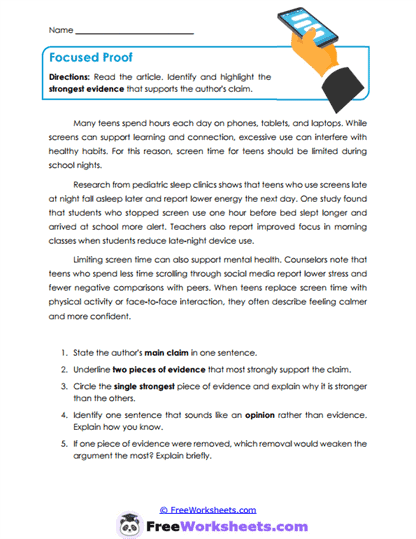
This worksheet really gets at something we push hard in middle school-not all evidence is equal. Students often think if they find any detail, they’re done. But here, they have to decide which piece of evidence is actually the strongest.
The topic (screen time and sleep) is something students immediately connect to, but the deeper goal is helping them become more thoughtful readers. I’d explain it to a parent like this: your child is learning to separate facts from opinions and to judge which facts actually matter most in an argument.
Curriculum and Grade Alignment
This aligns with Grade 8 standards around analyzing arguments and evaluating evidence. Students must identify claims, distinguish evidence from opinion, and evaluate strength. It supports Common Core RI.8.8 and TEKS ELAR 8.6(E).
Student Tasks
Students read a passage about screen time and its effects. Then they:
- Identify the main claim
- Find multiple pieces of supporting evidence
- Decide which piece is strongest (and explain why)
- Spot an opinion vs. a fact
- Think about how removing evidence affects the argument
This is higher-level thinking-students are judging, not just finding.
Common Challenges and Misconceptions
Students often think longer evidence = better evidence. Others confuse opinions with facts if they “sound true.” Explaining why one piece is stronger than another can be tough at first. They need practice justifying their thinking.
Implementation Guidance
This works really well as a discussion activity. Let students debate which evidence is strongest-that’s where the learning happens. At home, you can ask, “Which detail actually proves the point best?” That keeps the focus on reasoning.
Details and Features
- Relatable, high-interest topic
- Focus on argument strength
- Mix of identification and explanation
- Encourages critical thinking