
About This Worksheet
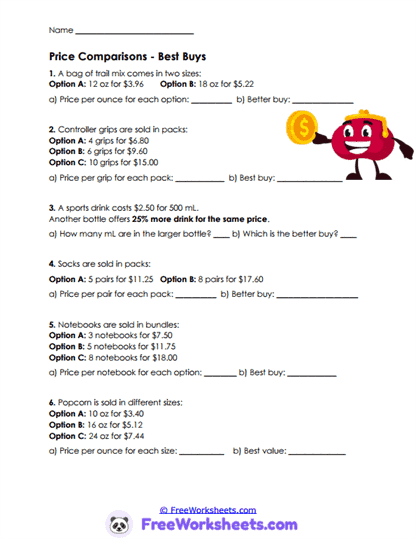
This worksheet helps students compare prices and determine which product is the best value. Learners calculate unit prices such as cost per ounce, cost per pair, or cost per notebook to compare different package sizes. Understanding value comparisons helps students make smarter shopping decisions in real life. For example, students may compare two snack sizes to see which option costs less per ounce. This activity strengthens division skills, decimal reasoning, and financial literacy understanding.
Curriculum and Grade Alignment
This worksheet focuses on unit price calculations and comparison shopping using decimals and division. Students should already understand decimal operations and basic unit rate concepts before beginning this activity. The primary learning goal is helping learners calculate cost per unit and compare values accurately. After mastering this skill, students are better prepared for budgeting, consumer decision-making, and proportional reasoning. The worksheet aligns with Common Core standards 7.RP.A.1 and 7.RP.A.3, along with TEKS 7.13A involving financial literacy and comparison shopping.
Student Tasks
On this worksheet, students will
calculate unit prices for snacks, socks, drinks, notebooks, and popcorn. Students compare products by finding the cost per ounce, pair, or item. Learners decide which option provides the best value based on the calculations. Several activities encourage students to explain why one purchase is a better deal than another. Students also practice organizing decimal calculations carefully while solving.
Common Challenges and Misconceptions
Many students compare total prices instead of comparing unit prices. Some learners divide incorrectly and create inaccurate cost-per-unit values. Others may forget to label their answers with units such as dollars per ounce or dollars per pair. Students can also struggle when package sizes are very different. Teachers can help by modeling how to calculate one unit price step by step before independent practice begins.
Implementation Guidance
Teachers may use this worksheet during financial literacy lessons, decimal review, or consumer math activities. The shopping comparisons help students connect math skills to everyday purchases. Parents and homeschool educators can work through one product comparison together before assigning independent work. Students often benefit from organizing unit prices into a chart before comparing. This worksheet also works well for homework, intervention, or enrichment review.
Details and Features
This printable worksheet includes shopping comparison problems involving snacks, drinks, socks, notebooks, and popcorn. The organized layout supports financial reasoning and careful decimal computation. Friendly graphics create an engaging learning environment while maintaining focus on mathematics. Problems are designed to strengthen consumer math fluency and practical decision-making skills. The worksheet prints clearly for classroom instruction, tutoring sessions, or homeschool use.