
Grade 5 Listening & Speaking Worksheets
Listening to a lecture and participating in a discussion require different but connected communication skills. These grade 5 listening and speaking worksheets have students take notes about ancient civilizations, distinguish claims from supporting evidence in an opinion speech, and prepare clarifying questions for a speaker. Other activities guide group discussions and oral summaries. The free printable PDFs suit learners developing active listening and organized responses. Model how to record brief notes rather than complete sentences, then let students use those notes to explain what they heard.
About This Collection of Worksheets
Effective listening and speaking involve more than hearing words or taking a turn to talk. Students need to identify important ideas, follow a speaker’s reasoning, ask useful questions, and respond in ways that keep a conversation moving. These skills support learning in language arts and across the curriculum.
The activities use a range of formats to build those habits. Students listen to informational passages and speeches, paraphrase a process, take notes on a short lecture, sequence spoken directions, and organize a story summary. Discussion pages help them share ideas, ask clarifying questions, use respectful sentence starters, take group roles, and reflect on how they participated.
Teachers can use these pages before, during, or after a read-aloud, presentation, partner discussion, or group task. Parents and tutors can read the passages aloud and pause when students need time to record a key point or prepare a response. Repeating a passage when needed gives learners another chance to listen for details and refine their notes.
Students learn these skills by using them in concrete situations: listening for a main idea, separating a claim from its evidence, or turning notes into a paraphrase. The worksheets move from understanding and organizing spoken information to responding and speaking with purpose. This practice helps students become more confident listeners and clearer contributors in classroom conversations.
Paul’s Teacher Tip
Before reading aloud, tell students what kind of information to listen for, such as a main idea, sequence, or supporting evidence. For note-taking tasks, model how to capture a short phrase instead of trying to write every word. When practicing questions or discussion stems, give students time to rehearse with a partner before sharing with the group. After an activity, ask what listening strategy helped them most and where they could use it again. For an added challenge, have students use their notes to give a brief oral summary without reading every word from the page.
Worksheet Collection Skill Spotlights
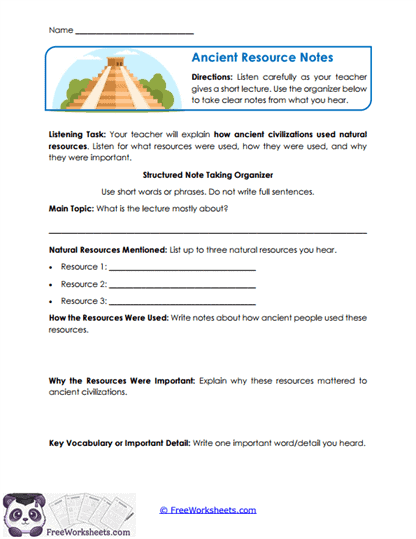
Ancient Resource Notes
What Kids Do: Students listen to a short lecture about how ancient civilizations used natural resources. They note the lecture’s main topic, record up to three resources, explain how people used them and why they mattered, then add one key vocabulary word or detail.
Target Skill: Organizing spoken information into topic, examples, uses, and significance helps students distinguish central ideas from supporting details. The note-taking structure encourages concise recording and gives students material they can use to summarize the lecture afterward.
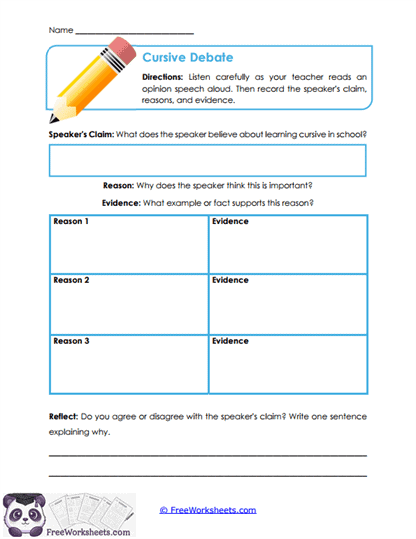
Claim and Evidence Notes
What Kids Do: Students listen to an opinion speech about whether cursive writing should be taught in school. They record the speaker’s claim, list up to three reasons, match evidence to each reason, and finish by stating whether they agree or disagree with a brief explanation.
Target Skill: Separating a claim, reasons, and evidence helps students follow the structure of a spoken argument. The worksheet also asks them to form a response of their own, building listening comprehension, critical thinking, and preparation for discussion or opinion writing.
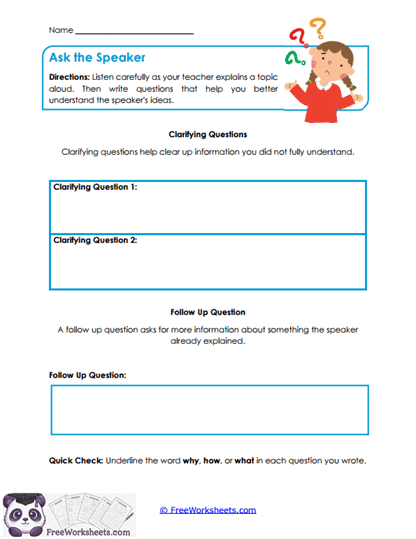
Clarifying Question Practice
What Kids Do: After listening to a teacher explain a topic, students write two questions to clear up information they did not understand and one follow-up question to learn more. They underline the question word they used, such as why, how, or what.
Target Skill: Distinguishing clarification from follow-up helps students respond to a speaker’s ideas with a clear purpose. Practicing specific questions builds active listening and supports stronger comprehension, classroom participation, and productive conversation.
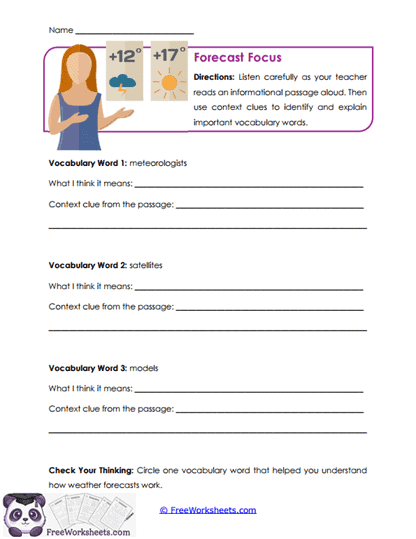
Context Clue Listening
What Kids Do: Students listen to an informational passage about weather forecasting and work out the meanings of meteorologists, satellites, and models. For each word, they write a possible meaning and identify the spoken detail that helped them figure it out.
Target Skill: Using oral context to infer word meaning helps students learn vocabulary even when they encounter an unfamiliar term during a lesson. Identifying the clue that supports a definition strengthens listening accuracy and encourages evidence-based reasoning.
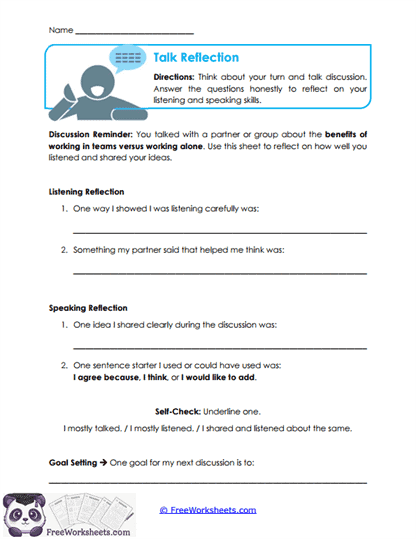
Discussion Reflection Check
What Kids Do: After a partner or group discussion about working in teams, students reflect on how they listened and contributed. They recall something useful a partner said, note an idea they shared, complete a participation self-check, and set one goal for their next discussion.
Target Skill: Reflecting on specific listening and speaking behaviors helps students recognize what productive participation looks like. Setting a focused goal turns discussion experience into a practical next step and supports collaboration and communication growth.
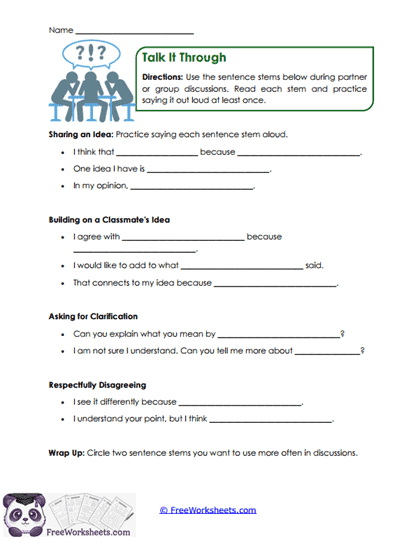
Discussion Sentence Starters
What Kids Do: Students complete sentence stems for sharing an idea, building on a classmate’s thinking, asking for clarification, and disagreeing respectfully. They practice the language aloud and choose two stems they would like to use in future discussions.
Target Skill: Rehearsing purposeful sentence starters gives students ways to enter and sustain a conversation. The prompts support respectful disagreement, clarification, and collaboration while helping students express ideas with confidence and consideration for others.
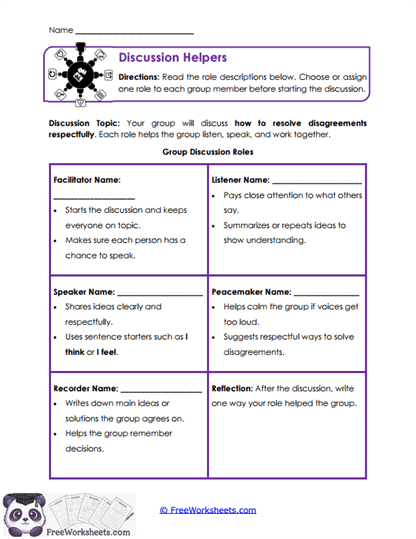
Group Discussion Roles
What Kids Do: Students review the facilitator, listener, speaker, peacemaker, and recorder roles before discussing how to resolve disagreements respectfully. Each student takes or is assigned a role, participates in the conversation, and reflects on how that role helped the group.
Target Skill: Learning how different responsibilities support a group builds students’ understanding of collaborative discussion. Practicing active listening, staying on topic, recording ideas, and working through disagreement strengthens communication and shared problem-solving.
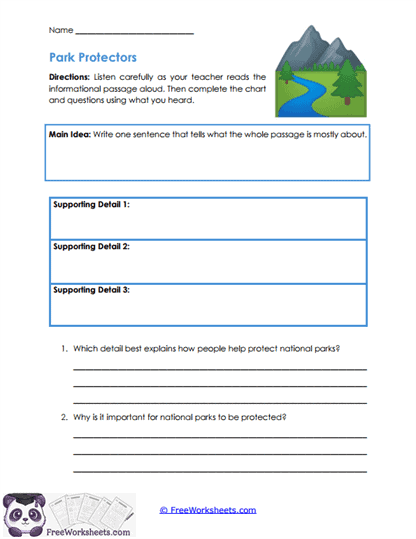
Main Idea Listening
What Kids Do: Students listen to an informational passage about protecting national parks, write the passage’s main idea, and record three supporting details. They answer two follow-up questions about a detail and why protecting parks matters.
Target Skill: Listening for the overall message while remembering relevant facts helps students distinguish a main idea from individual details. The organizer supports comprehension and note-taking, and the questions give students practice explaining what they heard.
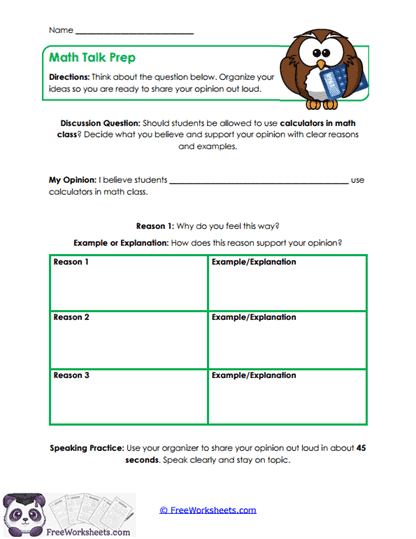
Opinion Talk Planner
What Kids Do: Students decide whether calculators should be allowed in math class, state their position, and plan three reasons with examples or explanations. They use the completed organizer to deliver an organized response aloud for about 45 seconds.
Target Skill: Planning an oral opinion helps students support a clear position with distinct reasons and relevant examples. The timed speaking task encourages organization, focus, and clear delivery, all useful for classroom discussions and presentations.
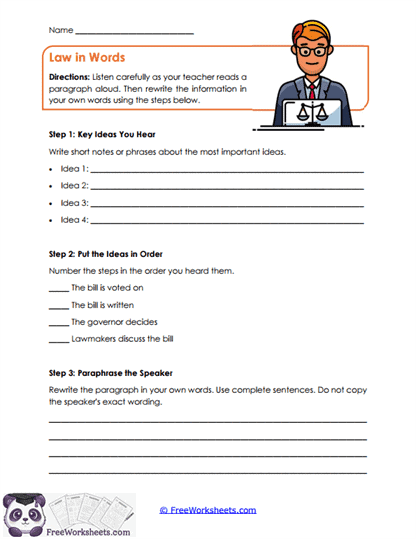
Paraphrase the Process
What Kids Do: Students listen to an explanation of how a bill becomes a law, jot down four key ideas, and number events in the order they hear them. They then use their notes to restate the process in complete sentences without copying the speaker’s wording.
Target Skill: Paraphrasing requires students to understand spoken information, select its essential points, and preserve the meaning while changing the wording. Sequencing and note-taking provide a clear path from listening to an accurate restatement.
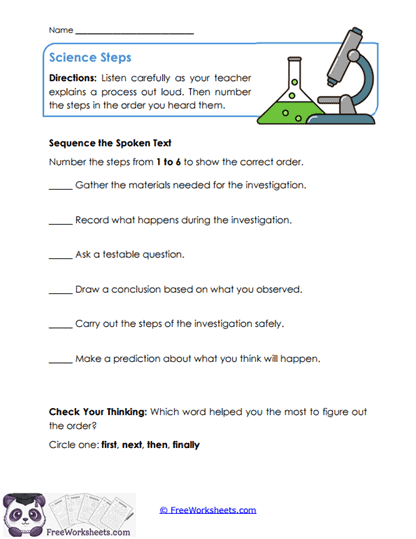
Science Sequence Listening
What Kids Do: Students listen to a spoken explanation of a science investigation, then number six listed actions in the order they heard them. They finish by circling the transition word-such as first, next, then, or finally-that helped them track the sequence.
Target Skill: Listening for sequence words helps students follow multi-step explanations and understand how a process unfolds. Ordering the investigation steps builds attention to spoken details and supports students in retelling or explaining a process in their own words.
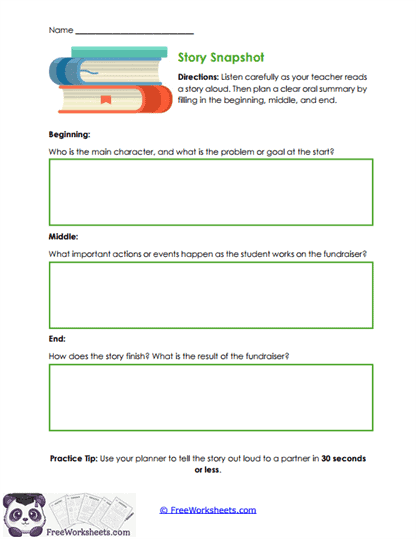
Story Summary Snapshot
What Kids Do: Students listen to a story about a student organizing a fundraiser and record key information in Beginning, Middle, and End boxes. They note the character and goal, important actions, and outcome, then use their organizer to retell the story to a partner in 30 seconds or less.
Target Skill: Selecting the most important events and placing them in order helps students summarize a narrative without retelling every detail. Using notes for a brief oral retell builds listening comprehension, sequencing, and speaking fluency.