
Factors, Multiples, And Divisibility Worksheets
5th grade math factors, multiples, and divisibility worksheets help students analyze number relationships, apply divisibility rules, and reason about shared factors and multiples. Free, ready-to-print worksheets in PDF format are designed for immediate classroom use, centers, guided practice, homework, or homeschool lessons. Students strengthen factor fluency, divisibility reasoning, and number sense while developing skills that support curriculum expectations.
About This Collection of Worksheets
Factors, multiples, and divisibility help 5th grade students understand how whole numbers are connected through multiplication and division. Students learn to identify factor pairs, generate multiples, test divisibility, classify prime and composite numbers, and recognize common factors and multiples. These ideas give learners a stronger understanding of number structure and prepare them for later work with fractions, ratios, and algebraic reasoning.
The collection includes factor-pair practice, multiple sequences, divisibility tables, prime-and-composite classification, greatest common factors, least common multiples, number relationships, sorting tasks, riddles, error analysis, equal-group arrangements, and proof-based challenges. Some worksheets emphasize direct skill practice, while others require students to explain why a number satisfies certain conditions or identify mistakes in another solution.
Teachers can use these worksheets for whole-class instruction, guided math, centers, homework, intervention, enrichment, or review. Parents, tutors, and homeschool educators can begin with factors and multiples before moving into GCF, LCM, divisibility, and reasoning challenges. Because the collection combines computation with explanation and proof, it helps students build both fluency and deeper understanding of how numbers relate.

Paul’s Teacher Tip
Encourage students to connect every factor question to a multiplication fact and every multiple question to a skip-counting pattern. When using divisibility rules, have them explain which rule applies instead of simply saying yes or no. For GCF, complete both factor lists before choosing the greatest shared value; for LCM, list multiples in order until the first common value appears. Remind students that factor and multiple relationships depend on order, so 4 is a factor of 20 while 20 is a multiple of 4. When students solve riddles or proof problems, have them check every condition before accepting an answer.
Worksheet Collection Skill Spotlights
Common Factor Hunt
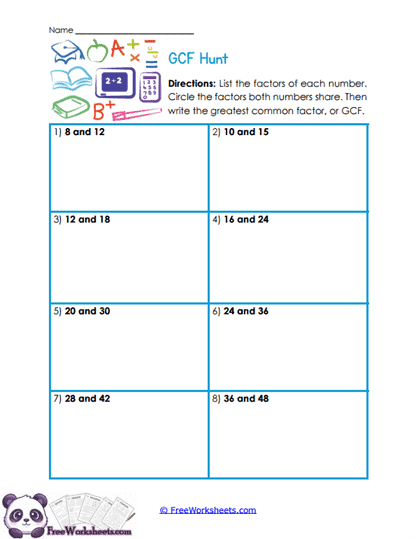
What Kids Do: Students solve eight greatest-common-factor problems by listing all factors of two numbers, identifying the values that appear in both lists, circling the shared factors, and selecting the greatest common factor for each number pair.
Target Skill: This activity develops organized GCF reasoning and factor fluency. 5th grade students practice completing factor lists accurately, distinguishing common factors from common multiples, and identifying the largest factor that divides both numbers evenly.
Divisibility Sorting
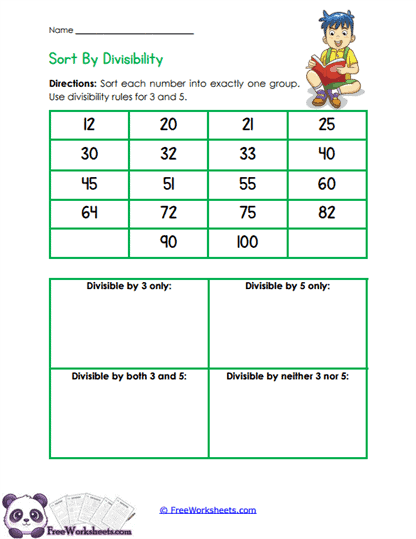
What Kids Do: Students classify a bank of numbers into four groups based on divisibility by 3 and 5. They test each number using divisibility rules and decide whether it belongs in the 3-only, 5-only, both, or neither category.
Target Skill: The worksheet strengthens mental divisibility reasoning and careful classification. 5th grade students practice applying more than one test to the same number and recognizing that a value may satisfy both rules before choosing its final category.
Equal Arrangements
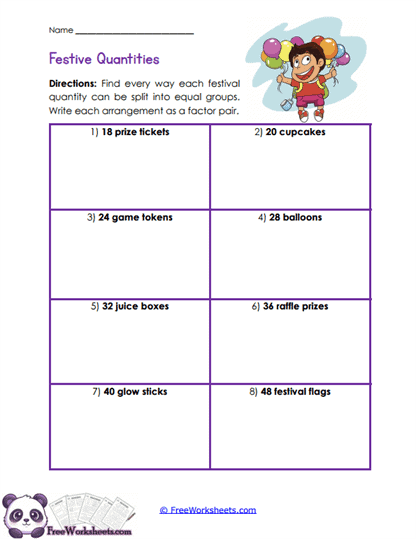
What Kids Do: Students find every possible equal-group arrangement for eight festival-themed quantities such as tickets, cupcakes, tokens, balloons, and flags. They represent each valid grouping as a multiplication factor pair and continue until all unique pairs are found.
Target Skill: This activity builds conceptual understanding of factors through equal grouping. 5th grade students connect factor pairs with arrays, multiplication, and division while learning to recognize when reversed pairs repeat the same underlying relationship.
Factor Pairs
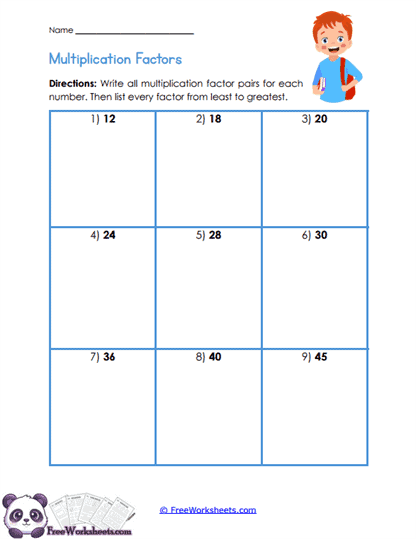
What Kids Do: Students work with nine target numbers and systematically list every multiplication pair that produces each value. After identifying the pairs, they organize the complete set of individual factors from least to greatest inside each work box.
Target Skill: The worksheet strengthens factor identification and multiplication fluency. 5th grade students learn to search for factors methodically, include 1 and the number itself, avoid duplicate pairs, and recognize when all possible factor relationships have been found.
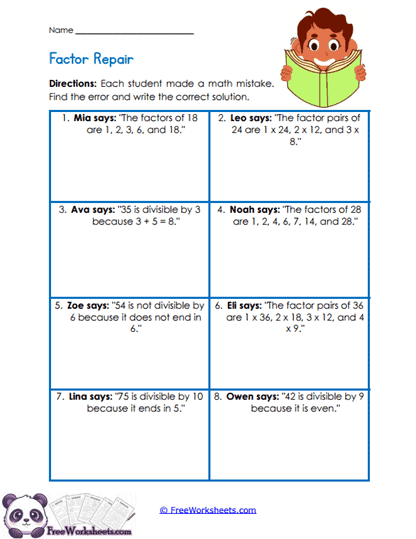
Mistake Repair
What Kids Do: Students examine eight incorrect statements about factors, factor pairs, and divisibility. They identify what is wrong in each claim, explain the error, and replace it with a corrected factor list, divisibility conclusion, or mathematical statement.
Target Skill: This activity develops error analysis and mathematical communication. 5th grade students practice applying factor and divisibility definitions carefully, locating the first faulty idea, and supporting corrections with multiplication, division, or complete factor evidence.
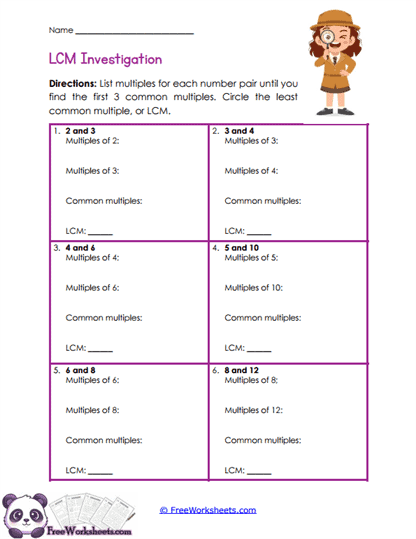
Multiple Investigator
What Kids Do: Students investigate six number pairs by listing multiples of each value side by side. They identify at least three shared multiples, circle the common values, and then select the smallest shared result as the least common multiple.
Target Skill: The worksheet builds understanding of LCM through visible number patterns. 5th grade students practice generating multiples in order, distinguishing multiples from factors, and recognizing that the first shared multiple in two ordered sequences is the least common multiple.
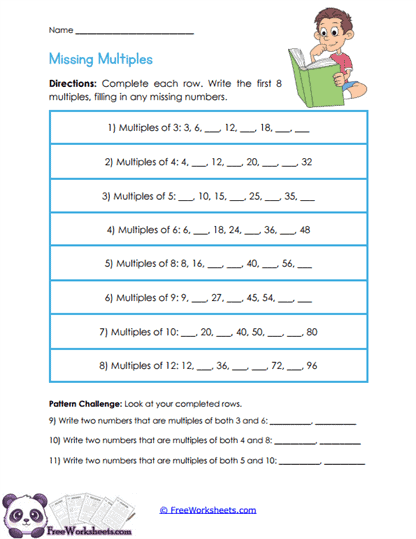
Multiple Patterns
What Kids Do: Students complete eight sequences of multiples for numbers such as 3, 4, 5, 6, 8, 9, 10, and 12. They then compare finished sequences to find numbers that appear in two multiplication patterns at the same time.
Target Skill: This activity strengthens multiplication patterns and prepares students for common-multiple reasoning. 5th grade students connect skip counting with repeated multiplication and begin recognizing how shared values lead naturally to least common multiples.
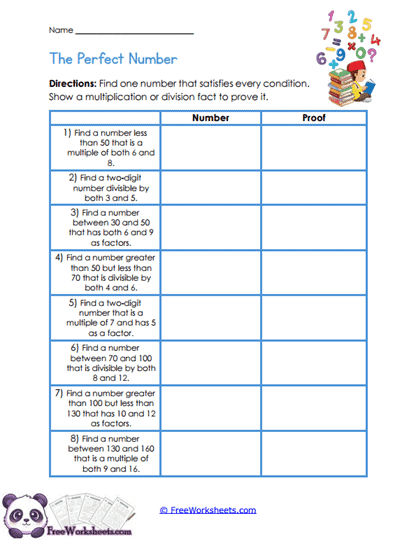
Number Proofs
What Kids Do: Students solve eight open-ended challenges by choosing a number that satisfies several factor, multiple, divisibility, or range conditions. They then write a multiplication or division equation that proves the selected value meets the requirements.
Target Skill: The worksheet develops logical reasoning and mathematical justification. 5th grade students practice checking several conditions at once, distinguishing factor language from multiple language, and supporting answers with clear numerical evidence instead of guessing.
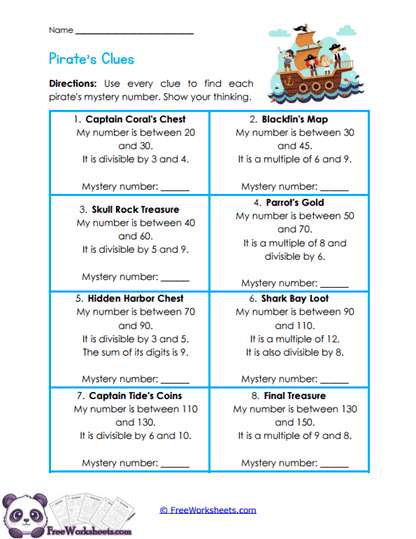
Pirate Riddles
What Kids Do: Students solve eight pirate-themed mystery-number problems that combine number ranges with divisibility, multiple, and digit-sum clues. They narrow the possibilities one clue at a time until they identify the single number that satisfies every condition.
Target Skill: This activity strengthens multi-clue reasoning and number sense. 5th grade students practice using divisibility tests, common multiples, and logical elimination while learning that a correct solution must satisfy every condition rather than only the first clue.
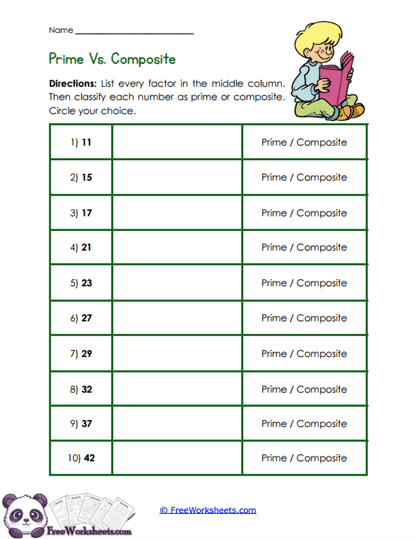
Prime Classifier
What Kids Do: Students list all factors for ten numbers and then use those factor lists to classify each value as prime or composite. They work with primes, odd composites, and even composites rather than relying on whether a number simply looks familiar.
Target Skill: The worksheet connects prime-and-composite classification directly to factor structure. 5th grade students reinforce that primes have exactly two factors while composites have more than two and use complete factor evidence to justify each classification.
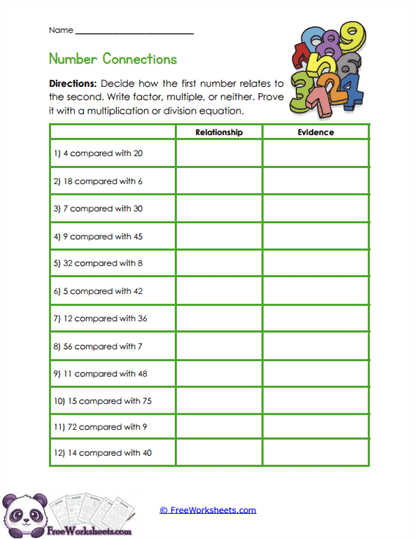
Relationship Reasoning
What Kids Do: Students examine twelve ordered number pairs and decide whether the first number is a factor of the second, a multiple of it, or neither. They then write a multiplication or division equation that proves the relationship they selected.
Target Skill: This activity develops precise understanding of factor and multiple language. 5th grade students practice reading relationships in the correct direction, connecting multiplication with division, and using equations as evidence for mathematical claims.
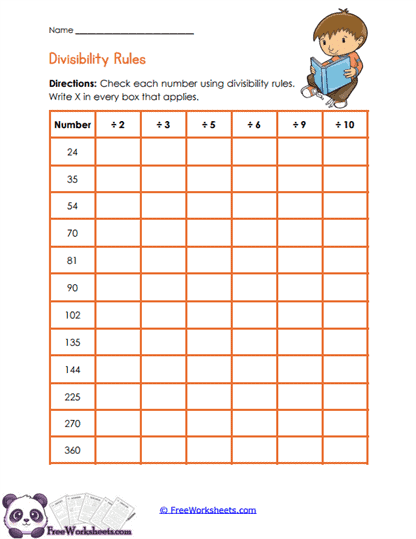
Rule Checker
What Kids Do: Students test twelve numbers for divisibility by 2, 3, 5, 6, 9, and 10 and place an X in every column that applies. They use ending digits, digit sums, and combined rules instead of performing full division repeatedly.
Target Skill: The worksheet strengthens efficient divisibility testing and number classification. 5th grade students practice applying several rules to one number, distinguishing similar rules such as 3 and 9, and recognizing that divisibility by 6 requires divisibility by both 2 and 3.