
Numerical Expressions Worksheets
5th grade math numerical expressions worksheets help students write, interpret, evaluate, compare, and organize expressions using multiple operations and grouping symbols. Free, ready-to-print worksheets in PDF format are designed for immediate classroom use, centers, guided practice, homework, or homeschool lessons. Students strengthen operation sense, symbolic reasoning, and order-of-operations skills while developing abilities that support curriculum expectations.
About This Collection of Worksheets
Numerical expressions help 5th grade students understand how numbers, operation symbols, and grouping marks work together to represent mathematical thinking. Students learn to translate words into expressions, describe expressions verbally, evaluate grouped calculations, and recognize how changing parentheses can change a value. These skills provide an important bridge between arithmetic and later algebraic reasoning.
The collection includes expression writing, verbal interpretation, evaluation, comparison, matching, contextual modeling, parentheses puzzles, error analysis, nested grouping, and target-value challenges. Some worksheets ask students to calculate results, while others deliberately focus only on writing or interpreting expressions so learners can concentrate on mathematical structure without being distracted by computation.
Teachers can use these worksheets for direct instruction, guided math, centers, homework, intervention, enrichment, review, or assessment preparation. Parents, tutors, and homeschool educators can begin with translation activities before progressing to evaluation, comparison, error analysis, and open-ended construction challenges. Because the collection moves between words, symbols, contexts, and values, it helps students develop a flexible understanding of numerical expressions.

Paul’s Teacher Tip
Have students identify the structure of an expression before they begin calculating. When parentheses appear, ask them to circle the grouped portion and explain why that calculation must happen first. During translation activities, encourage students to use words such as sum, difference, product, and quotient rather than simply reading symbols aloud. If students make an order-of-operations mistake, have them locate the first incorrect step instead of immediately redoing the entire problem. Comparing two expressions with the same numbers is also a powerful way to demonstrate why grouping and operation placement matter.
Worksheet Collection Skill Spotlights
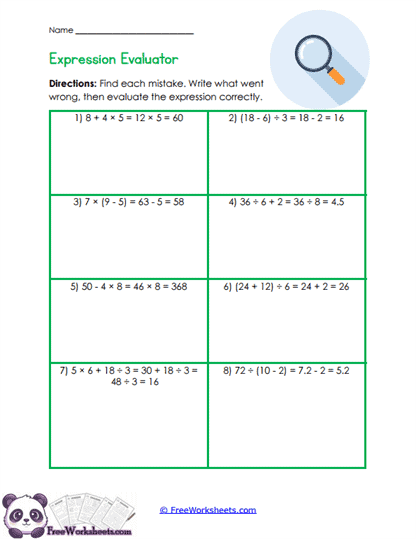
Error Tracker
What Kids Do: Students inspect eight incorrectly evaluated numerical expressions and determine where each solution first goes wrong. They analyze errors involving grouping, multiplication, division, subtraction, and improper left-to-right processing before evaluating every original expression correctly.
Target Skill: This activity strengthens order-of-operations reasoning through error analysis. 5th grade students practice distinguishing computational mistakes from structural mistakes and learn to identify which operation should have been completed first before repairing the entire solution.
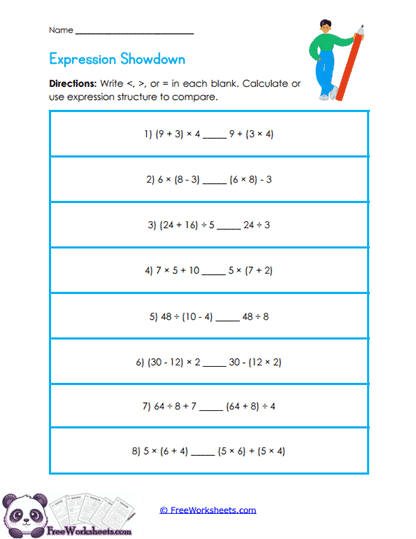
Expression Faceoff
What Kids Do: Students compare eight pairs of related numerical expressions that use similar numbers but different grouping or operation placement. They evaluate or reason about each side and then write <, >, or = to show how the resulting values compare.
Target Skill: The worksheet develops structural reasoning and expression comparison. 5th grade students learn that identical numbers do not guarantee identical values and practice using parentheses, operation priority, and number sense to explain why two expressions may be equal or unequal.
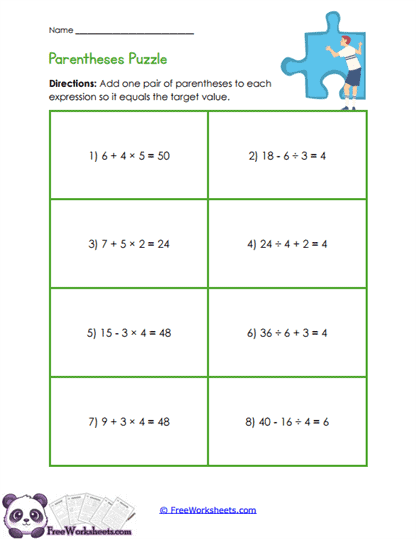
Grouping Puzzle
What Kids Do: Students complete eight puzzles by inserting exactly one pair of parentheses into each ungrouped expression so the calculation reaches a specified target value. They test possible placements, evaluate the revised expressions, and confirm whether each grouping produces the required result.
Target Skill: This activity develops flexible understanding of how grouping symbols change expression value. 5th grade students practice manipulating mathematical structure deliberately and see that parentheses control which calculation is completed first rather than serving as decorative notation.
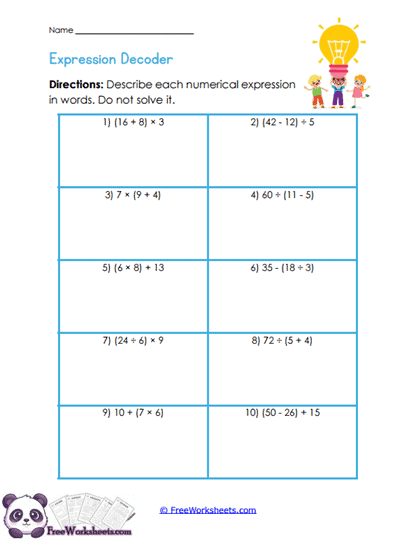
Math Translator
What Kids Do: Students examine ten numerical expressions containing addition, subtraction, multiplication, division, and parentheses and describe each one clearly in words without solving. They explain the grouped calculation first and then describe how its result is used in the remaining operation.
Target Skill: The worksheet strengthens mathematical vocabulary and symbolic interpretation. 5th grade students practice translating notation into phrases involving sums, differences, products, and quotients while preserving the exact grouping and sequence represented by the expression.
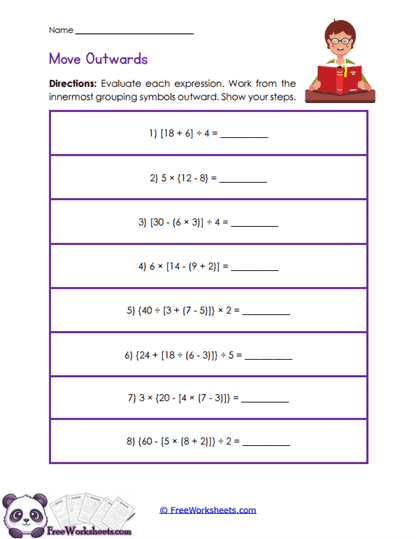
Nested Steps
What Kids Do: Students evaluate eight expressions containing grouping symbols and increasingly complex nested structures. They begin with the innermost parentheses or brackets, simplify one section at a time, rewrite the expression after each step, and continue outward until reaching the final value.
Target Skill: This activity develops organized order-of-operations reasoning with nested grouping. 5th grade students practice tracking expression structure carefully, avoiding skipped operations, and understanding how inner calculations create values that are then used by outer operations.
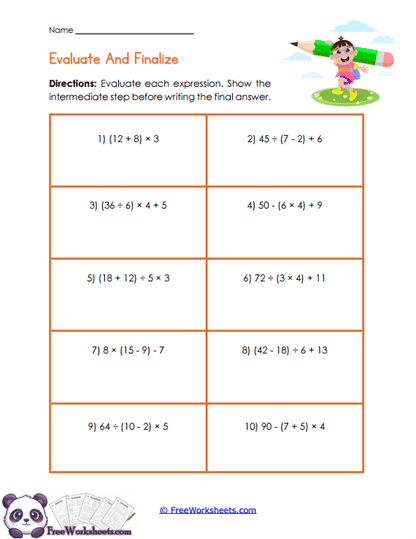
Operation Solver
What Kids Do: Students evaluate ten mixed-operation expressions containing parentheses and show an intermediate step before recording each final answer. They calculate grouped portions first, rewrite the simplified expression, and then complete the remaining operations in the proper sequence.
Target Skill: The worksheet builds procedural fluency with numerical-expression evaluation. 5th grade students practice respecting grouping symbols, maintaining operation order after parentheses are removed, and showing enough intermediate work to make their mathematical reasoning easy to follow.
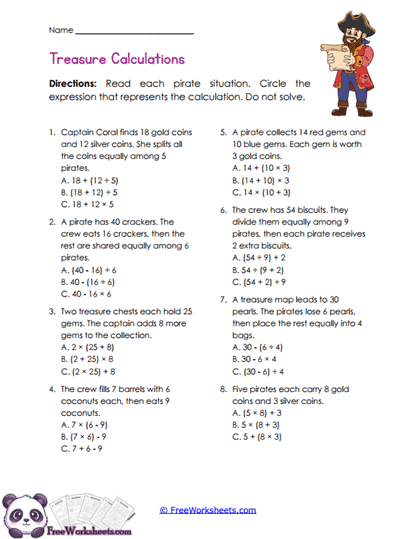
Pirate Planning
What Kids Do: Students read seven pirate-themed scenarios involving treasure, food, coins, crates, gems, and shared quantities. For each story, they compare three possible numerical expressions and circle the one that correctly represents the described sequence without solving it.
Target Skill: This activity strengthens mathematical modeling and contextual expression interpretation. 5th grade students practice translating real-world actions into grouped operations and recognizing that an expression can contain the right numbers yet still be incorrect if its operation order does not match the story.
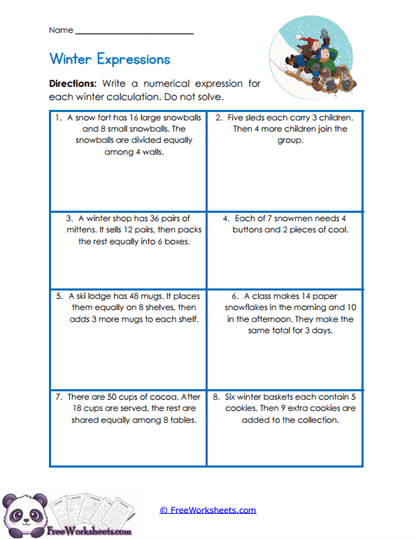
Seasonal Statements
What Kids Do: Students read eight winter-themed situations involving snowballs, sleds, mittens, snowmen, mugs, snowflakes, cocoa, baskets, and cookies. They identify the sequence of actions and write a numerical expression that represents each calculation without finding the answer.
Target Skill: The worksheet develops contextual translation from written situations to mathematical notation. 5th grade students practice deciding which quantities must be grouped, choosing appropriate operations, and representing multi-step relationships accurately without relying on answer choices.
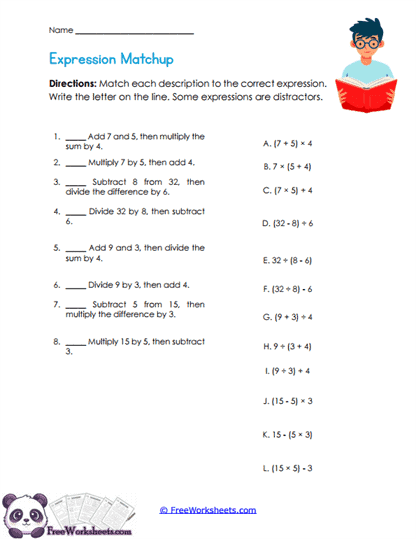
Structure Match
What Kids Do: Students read eight verbal calculation descriptions and match each one with the correctly structured expression from a bank of twelve choices. They compare parentheses, operation order, and subtraction or division direction while ignoring several deliberately similar distractors.
Target Skill: This activity strengthens precision in translating mathematical language into symbols. 5th grade students practice distinguishing expressions that contain the same numbers but represent different procedures and learn to use grouping marks as evidence when selecting a correct match.
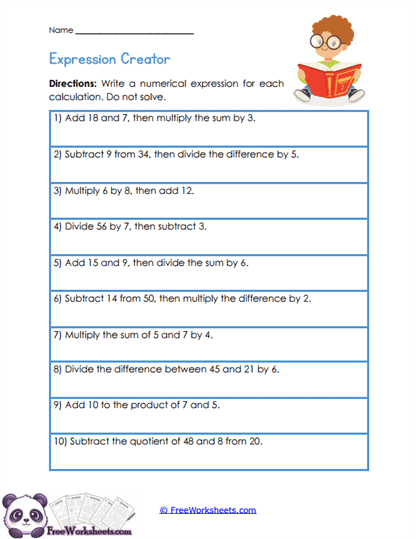
Symbol Builder
What Kids Do: Students translate ten written calculation directions into numerical expressions without solving them. They interpret phrases involving sums, differences, products, quotients, and sequential actions and decide where parentheses are required so the notation matches the intended calculation.
Target Skill: The worksheet develops expression construction and mathematical language fluency. 5th grade students practice converting verbal instructions into accurate symbolic form while recognizing that grouping symbols are essential when a calculation must occur before another operation.
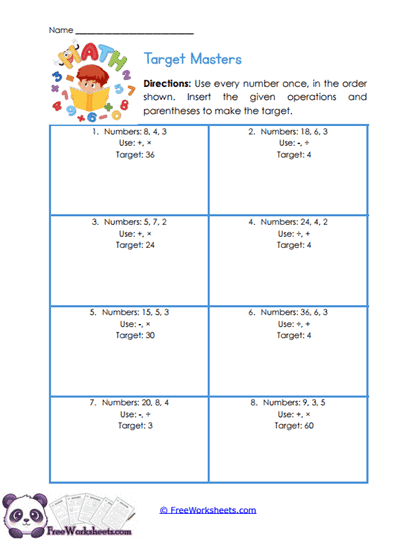
Target Builder
What Kids Do: Students solve eight open-ended target challenges using three numbers in a required order and two specified operations. They insert the operations and parentheses strategically, evaluate possible arrangements, and continue adjusting the structure until the expression equals the target value.
Target Skill: This activity develops flexible expression construction and problem solving. 5th grade students explore how changing grouping or operation placement affects value while honoring constraints involving number order, required symbols, and exact target results.
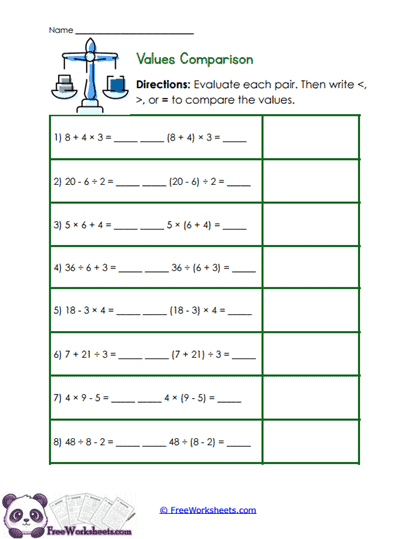
Value Faceoff
What Kids Do: Students evaluate eight pairs of numerical expressions that often use the same numbers in different structures. They calculate both values, record each result, and then use <, >, or = to compare expressions containing addition, subtraction, multiplication, division, and parentheses.
Target Skill: The worksheet strengthens expression evaluation and comparison while emphasizing the effect of grouping. 5th grade students practice applying operation rules consistently and learn to distinguish the appearance of an expression from the actual numerical value produced by its structure.