
Addition And Subtraction Worksheets
5th grade math addition and subtraction worksheets help students calculate with large numbers, decimals, estimates, unknown values, and real-world situations. Free, ready-to-print worksheets in PDF format are designed for immediate classroom use, centers, guided practice, homework, or homeschool lessons. Students strengthen place-value reasoning, computation accuracy, and problem solving while developing skills that support curriculum expectations.
About This Collection of Worksheets
Addition and subtraction in 5th grade requires students to work accurately with larger whole numbers and decimals while understanding how place value controls each calculation. Students practice regrouping, aligning decimal points, estimating results, using inverse operations, and checking completed work. These skills help learners move beyond simply finding answers and toward understanding whether their calculations are organized and reasonable.
The collection includes standard-algorithm practice, decimal alignment, estimation, error analysis, missing-number equations, operation-choice word problems, budgets, travel situations, true-or-false equations, and open-ended equation building. Some worksheets emphasize direct computation, while others require students to analyze mistakes, select an operation, compare estimates with exact results, or create equations that satisfy specific conditions.
Teachers can use these worksheets for guided math, centers, homework, intervention, review, enrichment, or assessment preparation. Parents, tutors, and homeschool educators can use the computation pages to reinforce accuracy and the reasoning activities to strengthen independence and checking habits. Because the collection blends whole numbers, decimals, estimation, equations, and applications, it prepares students for more advanced work with fractions, algebra, and multi-step problem solving.

Paul’s Teacher Tip
Make place-value alignment the first check students perform before any addition or subtraction calculation. With decimals, have students draw a vertical line through the decimal points and add placeholder zeros when they make the columns easier to see. Encourage estimation before solving larger problems so students already know the approximate size of a reasonable answer. When an unknown appears in an equation, ask students to read the equation aloud and use the inverse operation instead of guessing. For error-analysis activities, have students locate the first incorrect step rather than focusing only on the final answer.
Worksheet Collection Skill Spotlights
Budget Balance
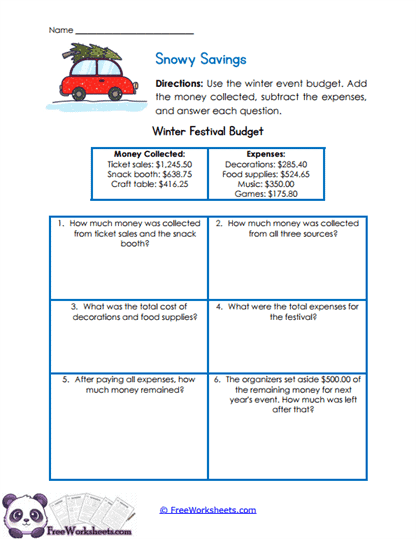
What Kids Do: Students read a winter festival budget table containing several income sources and expenses, then answer six questions by combining money collected, totaling costs, subtracting expenses, and determining how much money remains for later uses.
Target Skill: This activity develops decimal addition and subtraction within a practical budgeting context. 5th grade students practice reading tables, aligning dollars and cents accurately, organizing several related values, and using totals and differences to make sense of a changing balance.
Column Precision
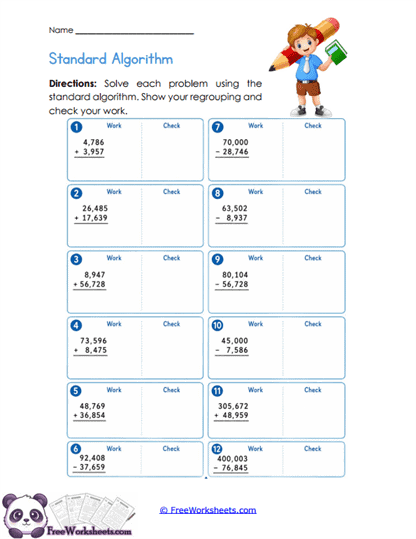
What Kids Do: Students solve twelve vertically arranged addition and subtraction problems using large whole numbers. Each problem includes separate areas for working through the standard algorithm and checking the result, encouraging students to show regrouping and verify their calculations.
Target Skill: The worksheet strengthens fluency with multi-digit addition and subtraction using the standard algorithm. 5th grade students practice precise place-value alignment, regrouping across several columns, and inverse-operation checking with values extending into the hundred-thousands.
Decimal Alignment
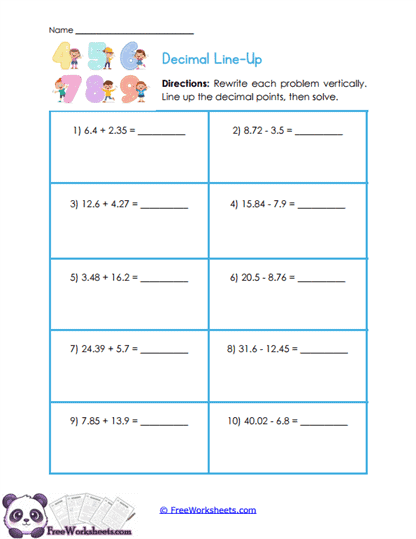
What Kids Do: Students rewrite ten horizontal decimal addition and subtraction equations vertically before solving. They line up decimal points, add placeholder zeros when useful, and calculate with numbers containing different amounts of tenths and hundredths.
Target Skill: This activity develops accurate decimal computation through place-value organization. 5th grade students reinforce that decimals must align by ones, tenths, and hundredths rather than by the final digit, helping prevent common errors when decimal lengths differ.
Equation Audit
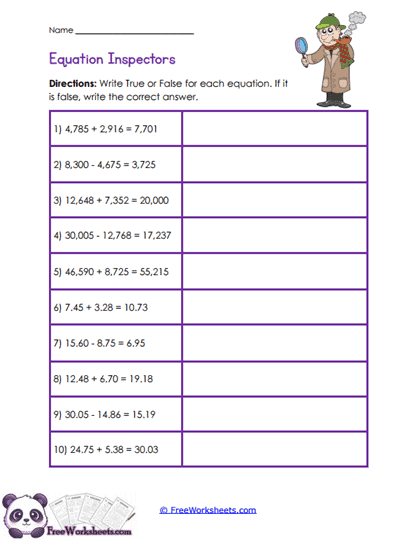
What Kids Do: Students inspect ten completed addition and subtraction equations involving large whole numbers and decimals. They label each statement True or False and calculate a corrected result whenever the printed equation does not accurately represent the sum or difference.
Target Skill: The worksheet strengthens mathematical verification across whole-number and decimal computation. 5th grade students practice checking regrouping, decimal alignment, and place value while learning to evaluate completed work instead of accepting a plausible-looking answer automatically.
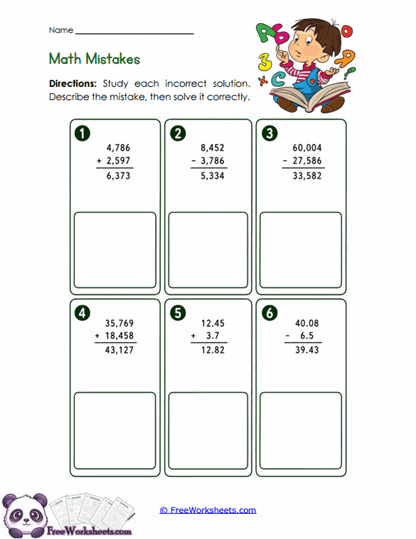
Error Detectives
What Kids Do: Students analyze six incorrectly solved addition and subtraction problems that mix large whole numbers with decimals. They identify and describe the mistake in each solution, then redo the calculation accurately and record the corrected result.
Target Skill: This activity develops error analysis and mathematical explanation. 5th grade students practice locating the first incorrect step, distinguishing regrouping mistakes from place-value or decimal-alignment errors, and explaining why a calculation failed before repairing it.
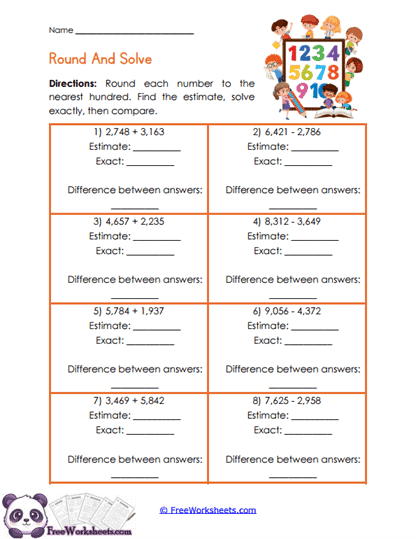
Estimate Compare
What Kids Do: Students complete eight addition and subtraction problems by rounding both values to the nearest hundred, finding an estimated result, solving the original equation exactly, and determining the numerical difference between the estimate and exact answer.
Target Skill: The worksheet connects rounding, estimation, and exact computation. 5th grade students develop stronger number sense by predicting reasonable answer ranges and then evaluating how closely an estimate represents the actual sum or difference.
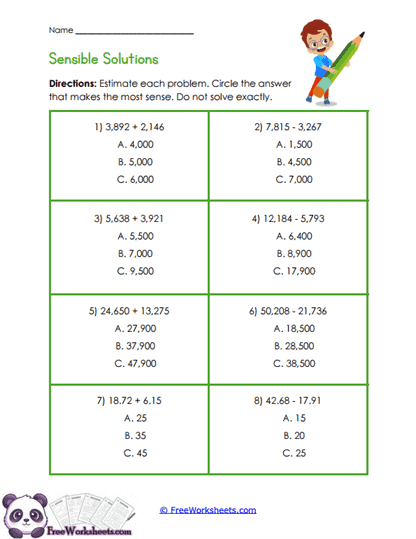
Estimate Sense
What Kids Do: Students examine eight addition and subtraction expressions and choose the most reasonable answer from three possibilities without calculating every problem exactly. They use rounding, friendly numbers, and magnitude reasoning with both whole numbers and decimals.
Target Skill: This activity strengthens mental estimation and mathematical judgment. 5th grade students learn to reject answers that are clearly too high or too low, use place value to predict approximate results, and develop a stronger habit of checking whether calculations make sense.
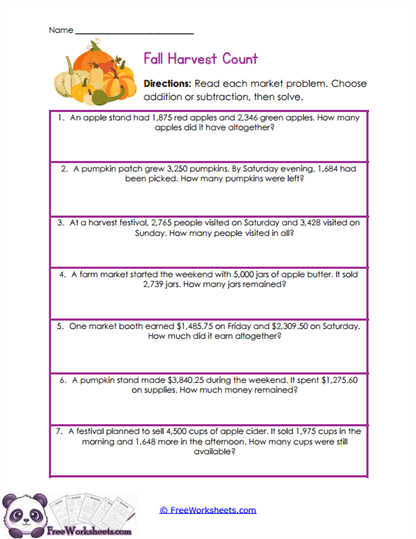
Harvest Calculations
What Kids Do: Students solve seven fall-themed word problems involving apples, pumpkins, visitors, jars, market earnings, expenses, and cider. They determine whether each situation requires addition or subtraction and then calculate with large whole numbers, money, or decimals.
Target Skill: The worksheet develops operation selection in real-world contexts. 5th grade students practice distinguishing situations where quantities are combined from those where amounts are removed or compared while applying accurate whole-number and decimal computation.
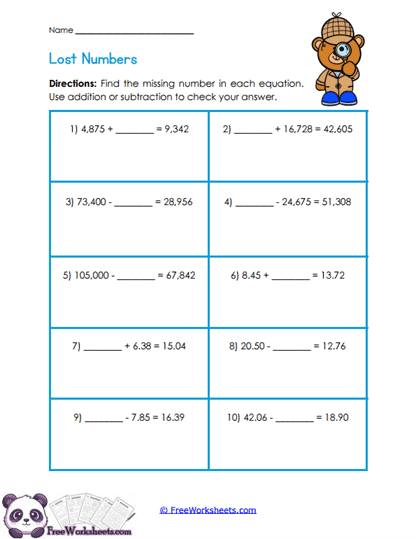
Missing Values
What Kids Do: Students complete ten equations containing an unknown addend, minuend, subtrahend, or other missing value. They work with both large whole numbers and decimals, choose addition or subtraction to work backward, and check each answer with the inverse operation.
Target Skill: This activity strengthens inverse-operation reasoning and early algebraic thinking. 5th grade students analyze equation structure, determine which quantity is unknown, and use related addition and subtraction facts to solve missing-number problems accurately.
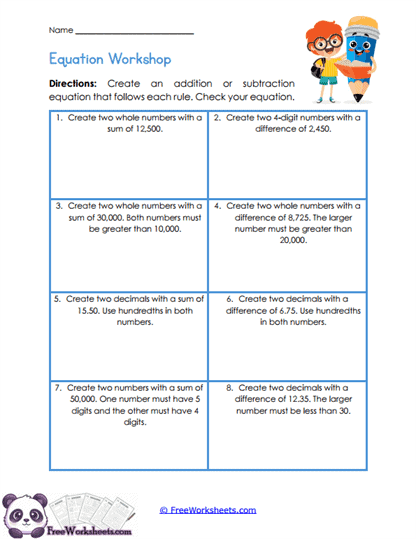
Number Builder
What Kids Do: Students complete eight open-ended prompts by creating their own addition or subtraction equations that produce specified sums or differences. Some prompts include extra conditions involving digit length or decimals written to the hundredths place.
Target Skill: The worksheet develops flexible number sense and equation construction. 5th grade students work backward from required results, apply inverse reasoning, satisfy multiple mathematical conditions, and discover that many different number pairs can create the same sum or difference.
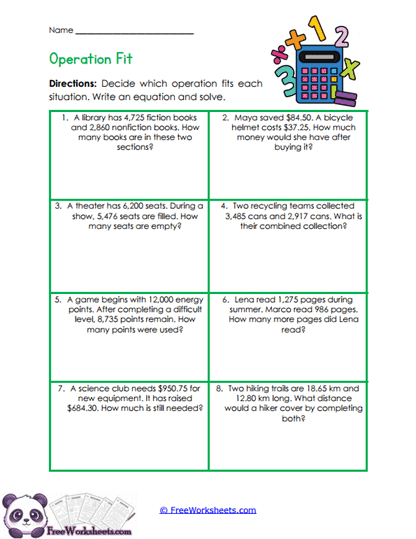
Operation Decisions
What Kids Do: Students read eight real-world word problems involving books, money, seating, recycling, game points, reading pages, budgets, and hiking distances. They choose addition or subtraction, write an equation that models each situation, and solve for the requested value.
Target Skill: This activity strengthens operation sense and mathematical modeling. 5th grade students practice interpreting what is happening in a story rather than relying on isolated keywords, then translate those relationships into accurate equations using whole numbers or decimals.
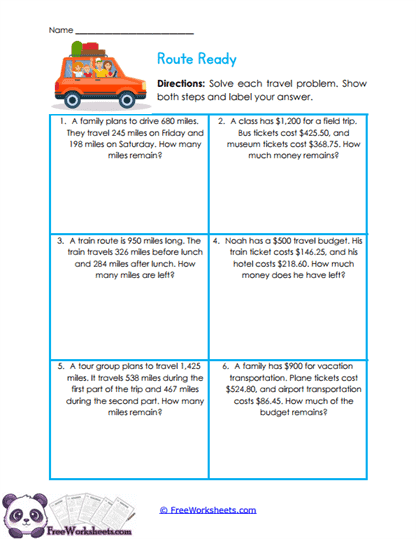
Travel Totals
What Kids Do: Students solve six two-step travel problems involving driving distances, trip expenses, train routes, hotels, airfare, tours, and transportation budgets. They complete and show two calculations, carry the first result into the next step, and label each final answer.
Target Skill: The worksheet develops multi-step addition and subtraction reasoning with distances and money. 5th grade students practice sequencing calculations, aligning decimal amounts accurately, tracking intermediate results, and connecting each numerical answer with its real-world unit.