
Powers Of Ten Worksheets
5th grade math powers of ten worksheets help students connect exponents, place value, multiplication, division, decimals, and number patterns. Free, ready-to-print worksheets in PDF format are designed for immediate classroom use, centers, guided practice, homework, or homeschool lessons. Students strengthen place-value reasoning, exponent understanding, and numerical magnitude while developing skills that support curriculum expectations.
About This Collection of Worksheets
Powers of ten help 5th grade students understand how place value changes when numbers are multiplied or divided by 10, 100, 1,000, and larger powers. Students connect exponent notation with repeated multiplication and standard form while observing how digits shift into places worth ten times more or one-tenth as much. This understanding provides a strong foundation for later decimal operations and scientific notation.
The collection includes exponent matching, place-value shifts, number patterns, division by powers of ten, exponent writing, contextual scaling problems, missing exponents, magnitude comparisons, error analysis, true-or-false statements, and reverse number transformations. Students work with both whole numbers and decimals, moving between symbolic notation, standard form, patterns, and real-world situations.
Teachers can use these worksheets for direct instruction, guided math, centers, homework, intervention, review, or assessment preparation. Parents, tutors, and homeschool educators can begin with exponent forms and place-value models before progressing to missing powers, comparisons, error analysis, and reverse reasoning. Because the collection repeatedly connects powers of ten with place value, students develop stronger number sense instead of relying only on memorized decimal-moving rules.

Paul’s Teacher Tip
Encourage students to describe what happens to the digits rather than saying that the decimal point simply “moves.” When multiplying by a power of ten, each digit shifts toward a place with greater value; when dividing, each digit shifts toward a place with smaller value. Have students connect the exponent in 10n with the number of factors of 10 and the number of place-value shifts involved. Before calculating, ask whether the result should become larger or smaller so students can catch direction errors. With decimals, tracing one specific digit from its starting place to its ending place can make the pattern especially clear.
Worksheet Collection Skill Spotlights
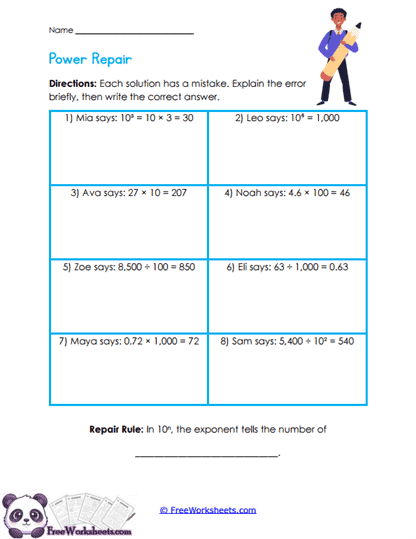
Error Repair
What Kids Do: Students inspect eight incorrect solutions involving exponent notation, multiplication by powers of ten, division by powers of ten, and decimal place-value changes. They identify the mistake, explain what went wrong, and then write the corrected result.
Target Skill: This activity develops error analysis and conceptual understanding of powers of ten. 5th grade students practice distinguishing exponent mistakes from place-value shift errors and use mathematical rules to justify why a corrected answer is reasonable.
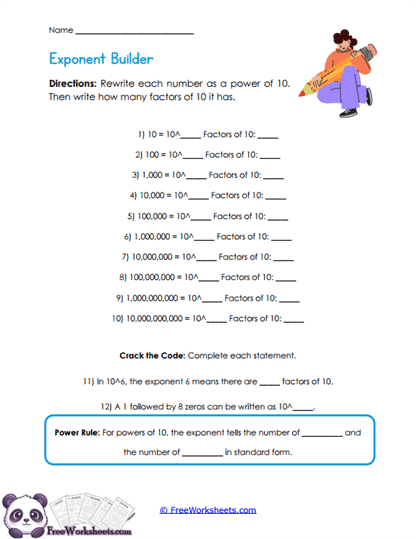
Exponent Builder
What Kids Do: Students examine ten standard-form powers of ten and rewrite each value using exponent notation. They also identify how many factors of 10 are represented and complete short statements that summarize the relationship among exponents, repeated multiplication, and standard form.
Target Skill: The worksheet strengthens understanding of exponent notation as repeated multiplication. 5th grade students connect the exponent with the number of factors of 10 and recognize the predictable relationship between powers of ten and the number of zeros in standard form.
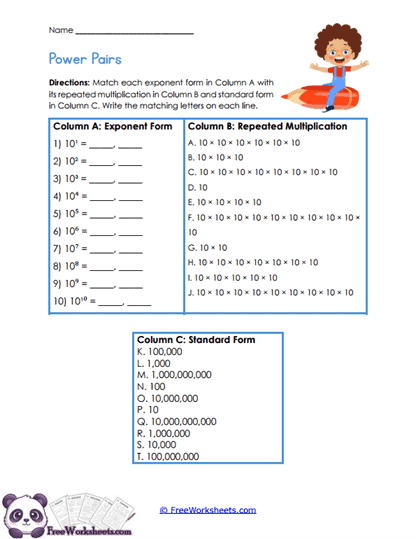
Exponent Match
What Kids Do: Students match powers of ten written in exponent form with their corresponding repeated-multiplication expressions and standard-form values. They work from 101 through much larger powers and record the letters that connect equivalent representations.
Target Skill: This activity develops fluency moving among exponent form, repeated multiplication, and standard form. 5th grade students learn that these are different representations of the same quantity and build a stronger conceptual understanding of what an exponent communicates.
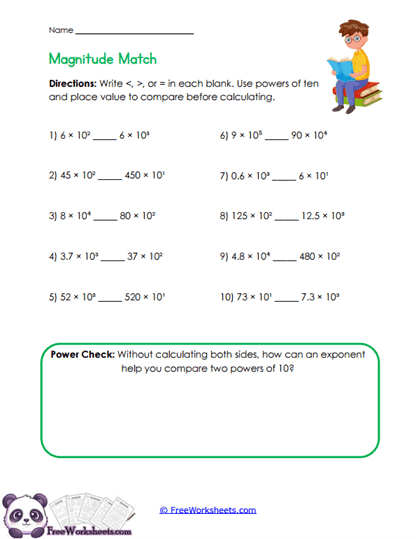
Magnitude Compare
What Kids Do: Students compare ten pairs of expressions containing coefficients and powers of ten. They analyze the exponent, coefficient, and resulting place-value magnitude and then write >, <, or = to show which expression represents the greater value.
Target Skill: The worksheet strengthens numerical magnitude and comparison reasoning with powers of ten. 5th grade students practice using exponent size as an efficient clue while also recognizing that coefficients must be considered before making a final comparison.
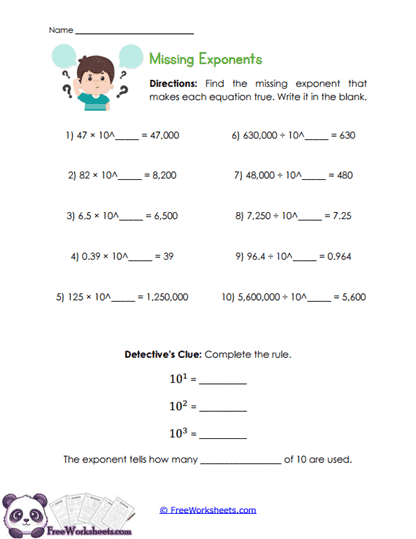
Missing Powers
What Kids Do: Students solve ten multiplication and division equations containing a missing exponent. They compare the starting and ending values, determine how many place-value positions the digits changed, and write the power of ten that makes each equation true.
Target Skill: This activity develops reverse reasoning with powers of ten and early algebraic thinking. 5th grade students connect the number of place-value shifts with the exponent and use multiplication or division direction to determine an unknown power accurately.
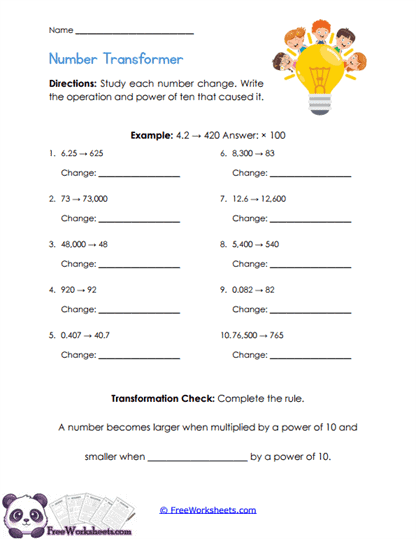
Number Changes
What Kids Do: Students study ten pairs showing a starting number and a transformed number. They determine whether multiplication or division caused the change and identify whether the number was changed by 10, 100, 1,000, or the corresponding power of ten.
Target Skill: The worksheet strengthens flexible place-value reasoning by requiring students to work backward. 5th grade students analyze how far digits shifted, identify whether the value increased or decreased, and name the operation and power responsible for the transformation.
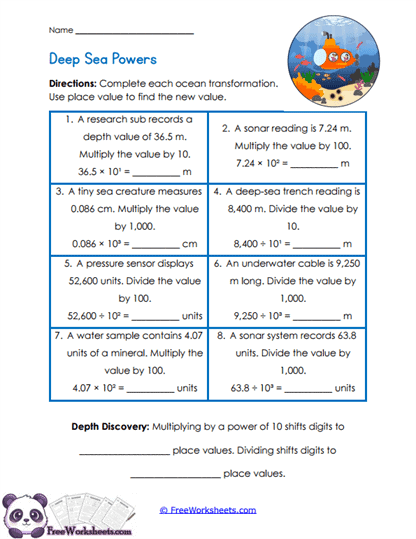
Ocean Scaling
What Kids Do: Students solve eight underwater-themed problems involving depths, sonar readings, cables, pressure values, and other quantities. They multiply or divide whole numbers and decimals by 10, 100, or 1,000 and record the resulting measurement.
Target Skill: This activity develops applied understanding of powers-of-ten scaling with decimals and whole numbers. 5th grade students practice predicting whether quantities should grow or shrink and matching the number of place-value shifts to the specified multiplier or divisor.
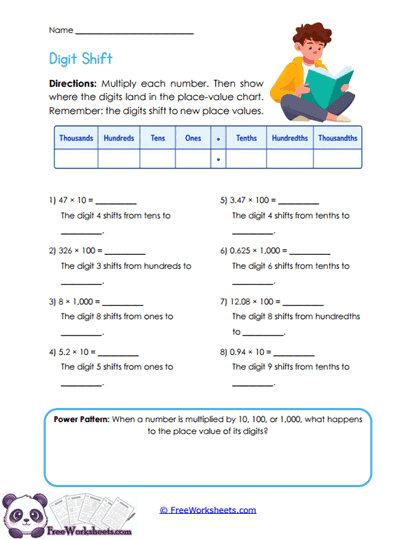
Place Shift
What Kids Do: Students multiply whole numbers and decimals by 10, 100, or 1,000 and use a place-value chart to track how a selected digit changes position. They record the new value and identify the starting and ending place of the digit.
Target Skill: The worksheet builds conceptual understanding of why multiplication by powers of ten changes digit value. 5th grade students focus on place-value movement rather than memorized decimal-point rules and connect each shift with a tenfold increase in value.
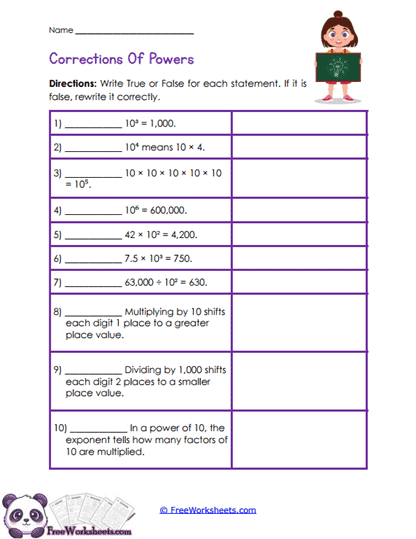
Power Corrections
What Kids Do: Students read ten statements about exponents, standard form, multiplication, division, and place-value shifts and classify each statement as true or false. Whenever a statement is false, they rewrite it so that the mathematical relationship becomes correct.
Target Skill: This activity strengthens mathematical verification and explanation with powers of ten. 5th grade students practice evaluating claims, correcting misconceptions about exponent meaning, and applying multiplication and division rules to justify accurate place-value relationships.
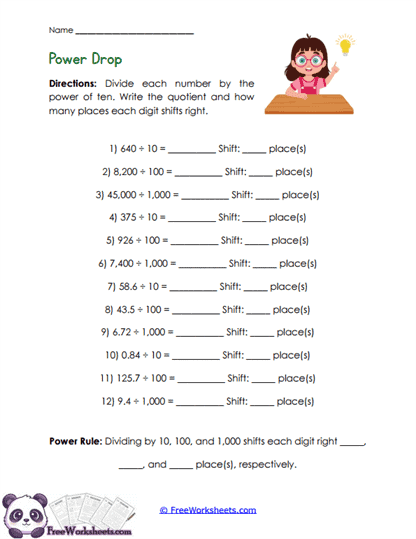
Power Division
What Kids Do: Students divide twelve whole numbers and decimals by 10, 100, or 1,000. For each problem, they calculate the quotient and record how many place-value positions the digits shift before completing a general rule about division by powers of ten.
Target Skill: The worksheet develops division-based place-value reasoning. 5th grade students practice matching zeros or exponents with the number of shifts and recognize that dividing by a power of ten moves digits into places with smaller values.
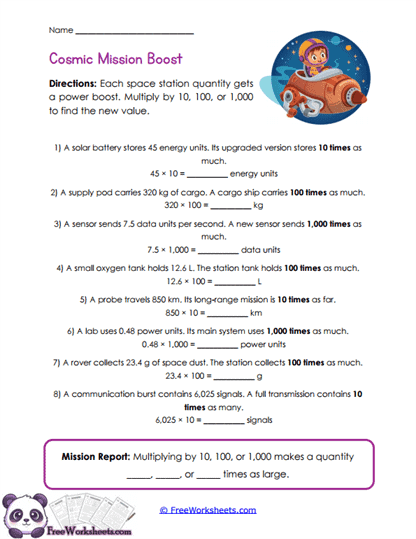
Space Scaling
What Kids Do: Students solve eight space-themed problems involving batteries, cargo, sensors, oxygen tanks, rovers, and other quantities. They multiply whole numbers or decimals by 10, 100, or 1,000 and determine the new scaled value in each situation.
Target Skill: This activity develops real-world application of powers-of-ten multiplication. 5th grade students connect phrases such as “10 times as much” or “1,000 times as much” with place-value changes and practice scaling decimal and whole-number quantities accurately.
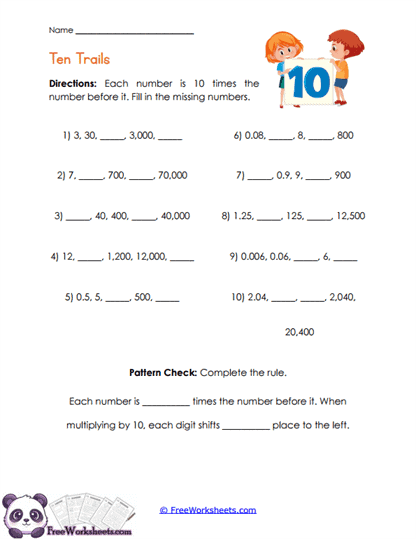
Ten Patterns
What Kids Do: Students complete ten number trails in which each value is ten times the value immediately before it. They fill missing positions in sequences containing whole numbers and decimals, work both forward and backward, and state the place-value pattern they observe.
Target Skill: The worksheet strengthens recognition of repeated powers-of-ten patterns. 5th grade students connect multiplication by 10 with successive place-value shifts and learn to extend or reverse sequences without relying on the misleading shortcut of simply adding zeros.